 Radmard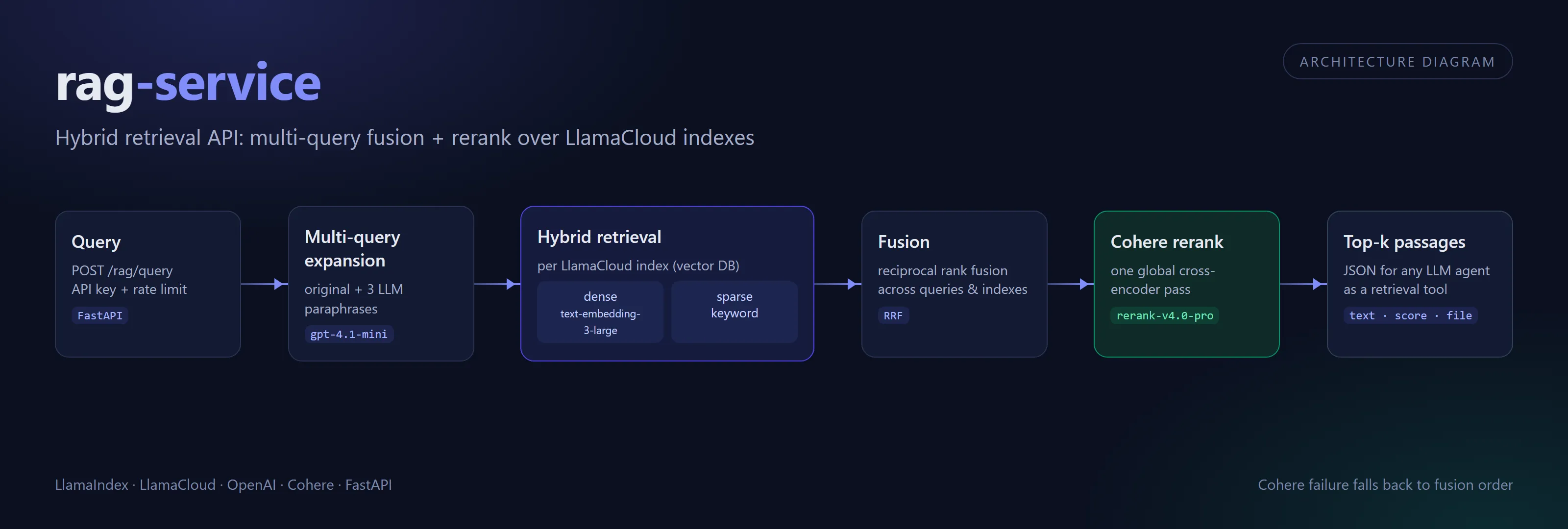
Hybrid retrieval API: multi-query fusion + rerank over LlamaCloud indexes. One HTTP call turns a user question into a short, reranked list of source passages that any LLM agent can use as a retrieval tool.
Highlights
- Two-stage retrieval, recall then precision: a wide hybrid (dense + sparse) search across several LlamaCloud vector indexes, then one global Cohere cross-encoder rerank.
- Multi-query expansion: the LLM writes 3 paraphrases of the question; all 4 queries hit every index and the results are merged with reciprocal rank fusion.
- Built to keep serving: Cohere failures fall back to fusion order instead of a 500, transient retrieval timeouts are retried once, index loading retries with backoff.
- Hardened for the open internet: fail-closed API key auth, constant-time key compare, per-client rate limit, schema-level query length cap, no internal errors or index names leaked, docs hidden unless
DEBUG. - Agent-ready output: plain JSON (
text,score,file_name), so it plugs in as a tool for any LLM agent platform (for example Dify or LangGraph). Multilingual: used in production on a Persian-language corpus.
Why it’s interesting
- One reranker, not two. LlamaCloud can rerank per index, but with N indexes x 4 queries that truncates each result list before fusion and reranks twice. Here per-index reranking is off (
ENABLE_RERANKING=False), so all raw hybrid candidates reach fusion and a single Cohere pass picks the final top-N (app/core/config.py,app/services/rag_service.py). - A rerank call that fits the network. Instead of LlamaIndex’s
CohereRerank(which sends metadata-padded text),_cohere_rerank_proxy_safesends only the firstCOHERE_MAX_DOCScandidates, plain text cut toCOHERE_DOC_CHARS, through a freshhttpxclient with an explicit timeout and optional proxy, then maps scores back onto the full-text nodes. Out-of-range result indexes are dropped. - Honest health check.
/rag/healthmakes no external calls and reportsreadyonly when every configured index produced a retriever and the reranker is configured. - Careful about what it does not do. No
LongContextReorder(the output is a ranked list, not a stuffed prompt), and no client-side embedding model: LlamaCloud embeds the query server-side with the model the index was ingested with.
Architecture
flowchart LR
    A[LLM agent / client] -->|POST /rag/query<br/>X-API-Key| B[FastAPI router<br/>auth, rate limit, validation]
    B --> C[QueryFusionRetriever<br/>original + 3 LLM paraphrases]
    C --> D1[LlamaCloud index 1<br/>dense + sparse]
    C --> D2[LlamaCloud index 2<br/>dense + sparse]
    C --> D3[LlamaCloud index N<br/>dense + sparse]
    D1 & D2 & D3 --> E[Reciprocal rank fusion<br/>top 72]
    E --> F[Cohere rerank<br/>first 40 docs, 1000 chars each]
    F -->|top 20| G[JSON: text, score, file_name]
    F -. Cohere error .-> H[fallback: fusion order]
    H --> G
Pipeline per request (RAGService.retrieve):
| Stage | What happens | Defaults (env) |
|---|---|---|
| Query expansion | QueryFusionRetriever asks the LLM for paraphrases | FUSION_NUM_QUERIES=4 (1 original + 3), LLM_MODEL=gpt-4.1-mini, LLM_TEMPERATURE=0.1 |
| Hybrid retrieval | Each query runs on every LlamaCloud index in chunks mode, dense + sparse, blended by alpha | DENSE_SIMILARITY_TOP_K=50, SPARSE_SIMILARITY_TOP_K=50, ALPHA=0.35, INDEX_NAMES |
| Fusion | Reciprocal rank fusion over all (query x index) lists, async | FUSION_MODE=reciprocal_rerank, FUSION_SIMILARITY_TOP_K=72 |
| Rerank | One Cohere call over the fused pool, scores replace fusion scores | COHERE_MODEL=rerank-v4.0-pro, COHERE_TOP_N=20, COHERE_MAX_DOCS=40, COHERE_DOC_CHARS=1000 |
| Response | Nodes mapped to {text, score, file_name} plus total, processing_time, echoed query | - |
Timeouts and retries: Cohere call timeout COHERE_HTTP_TIMEOUT (25 s in code, 45 s in .env.example); fusion retried once when the error looks transient (timeout, connection reset); each index load retried up to 5 times at startup; Gunicorn worker timeout 300 s in the Dockerfile. There is no response cache and no score threshold: the result is always the reranked top-N (or fewer).
Embeddings: the indexes were ingested in LlamaCloud with OpenAI text-embedding-3-large (3072 dims). The query embedding is computed by LlamaCloud with the same model; EMBEDDING_MODEL in config is documentation only.
Tech stack
FastAPI, Pydantic v2, LlamaIndex (QueryFusionRetriever), LlamaCloud managed indexes (hybrid vector + keyword search), OpenAI (gpt-4.1-mini for query expansion, text-embedding-3-large at ingestion), Cohere Rerank, Gunicorn + Uvicorn workers, uv, Docker Compose.
API
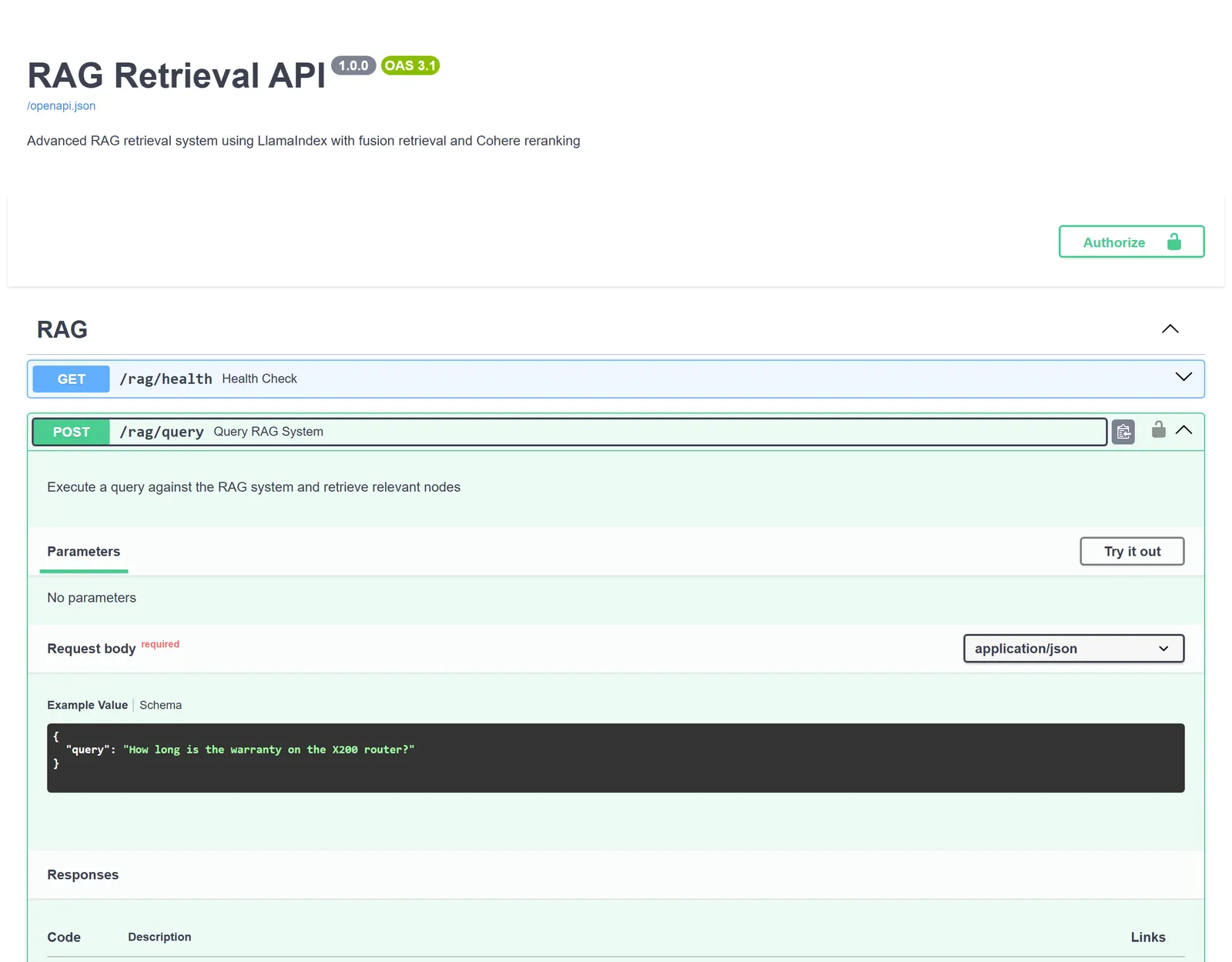
POST /rag/query with header X-API-Key:
curl -X POST http://127.0.0.1:8000/rag/query \
  -H "Content-Type: application/json" \
  -H "X-API-Key: $APP_API_KEY" \
  -d '{"query": "How long is the warranty on the X200 router?"}'
Response (fictional content):
{
  "nodes": [
    {
      "text": "All X200 routers ship with a 24-month limited warranty covering hardware defects...",
      "score": 0.91,
      "file_name": "x200-warranty.md"
    },
    {
      "text": "To start a warranty claim, contact support with the serial number printed under the device...",
      "score": 0.62,
      "file_name": "support-claims.md"
    }
  ],
  "total": 2,
  "processing_time": 3.45,
  "query": "How long is the warranty on the X200 router?"
}| Endpoint | Auth | Notes |
|---|---|---|
GET / | none | Basic info |
GET /rag/health | none | {"status": "ready", "indexes_loaded": 3}; index names only when DEBUG=true |
POST /rag/query | X-API-Key | 403 bad/missing key, 422 empty or over MAX_QUERY_LENGTH, 429 with Retry-After, 500 with a correlation id only |
GET /docs | none | Swagger UI, mounted only when DEBUG=true |
Getting started
Requirements: Python 3.13, uv, API keys for LlamaCloud, OpenAI and Cohere, and one or more LlamaCloud indexes.
uv sync
cp .env.example .env   # fill in keys, INDEX_NAMES, PROJECT_NAME, APP_API_KEY
uv run uvicorn app.main:app --host 127.0.0.1 --port 8000
The app refuses to start without APP_API_KEY. Production-style run (same as the container):
uv run gunicorn app.main:app -k uvicorn.workers.UvicornWorker -w 4 -b 0.0.0.0:8000 --timeout 300Docker:
docker build -t rag-service .
IMAGE_NAME=rag-service PROJ_NAME=rag-service PORT_NUM=8000 LOG_ADDRESS=udp://127.0.0.1:12201 LOG_TAG=rag-service docker compose up -d
compose.yml adds a health check, no-new-privileges, dropped capabilities, memory/CPU limits and GELF logging. All settings are listed in .env.example.
Tests
uv run pytest -q20 unit tests, all external services mocked:
tests/test_rag_service.py: rerank reordering and score mapping, dropping out-of-range indexes, doc cap and text truncation,top_nbound, fallback to fusion order on Cohere failure, retry-once on transient retrieval errors (and no retry on other errors), health readiness.tests/test_api.py: response mapping, API key checks (403 / fail-closed 503), request validation (422 / 400), rate limit 429 withRetry-After, no leaking of internal errors,index_nameshidden unlessDEBUG.
Project layout
app/
  main.py               FastAPI app, lifespan, CORS, docs gating
  dependencies.py       API key check, service singleton
  core/config.py        all env settings with defaults
  routers/rag.py        /health, /query, rate limiter
  schemas/rag.py        request/response models
  services/rag_service.py  fusion retrieval + Cohere rerank
tests/                  pytest unit tests
License
MIT, see LICENSE.
Built by Sepehr Radmard · LinkedIn · GitHub · more projects on my profile