 Radmard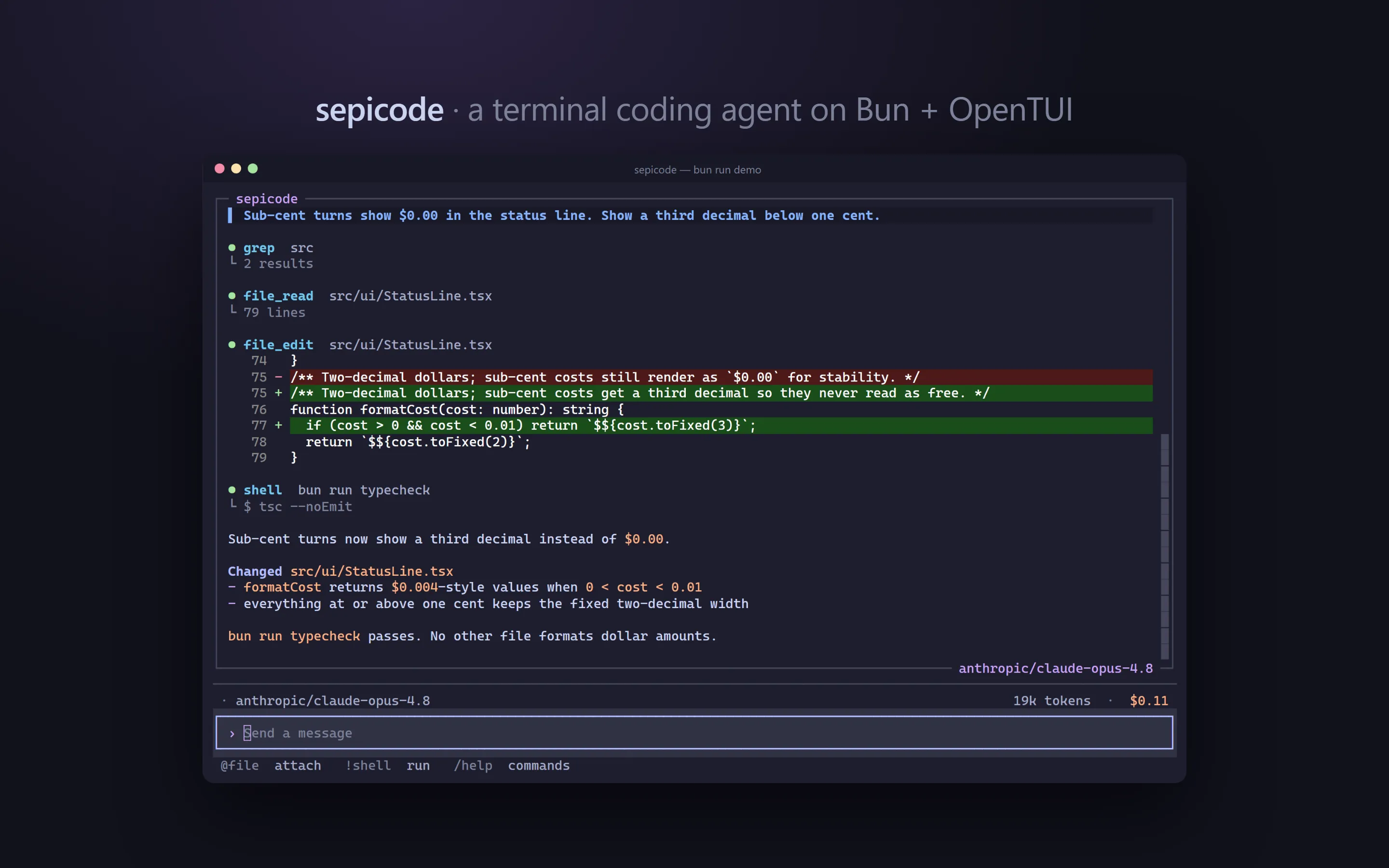
A full-screen terminal coding agent that reads, edits, searches and runs your code, with hard step and dollar caps on every turn.
A terminal coding agent with a full-screen TUI, running on Bun. The agent loop comes from @openrouter/agent and the UI is React rendered by @opentui/react. Any OpenRouter model works; the default is anthropic/claude-opus-4.8.
Highlights
- Full-screen React TUI: streaming Markdown, live tool-call timeline, inline colored diffs, running token and cost totals.
- Nine tools (files, search, shell, web search, read-only sub-agent) behind zod schemas.
- Every turn capped on steps and USD; Esc interrupts mid-turn.
- Offline demo mode (
bun run demo) that drives the real UI with a scripted agent, no API key needed.
Screenshots
All screenshots, including the one at the top, are the real TUI running bun run demo (scripted agent, demo data), captured in a PTY and rendered with xterm.js. The working directory shown is a placeholder set by the capture script.
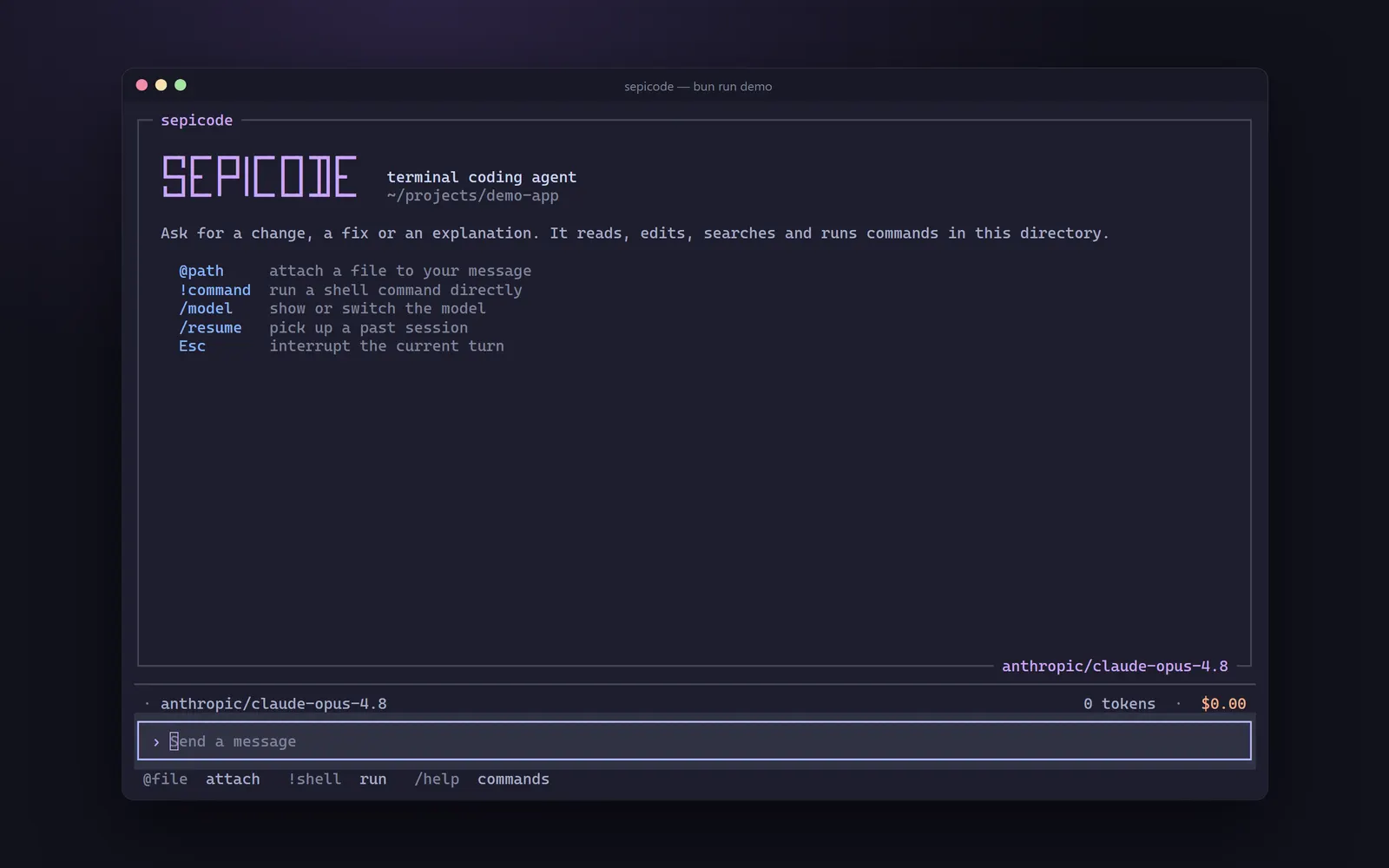 | 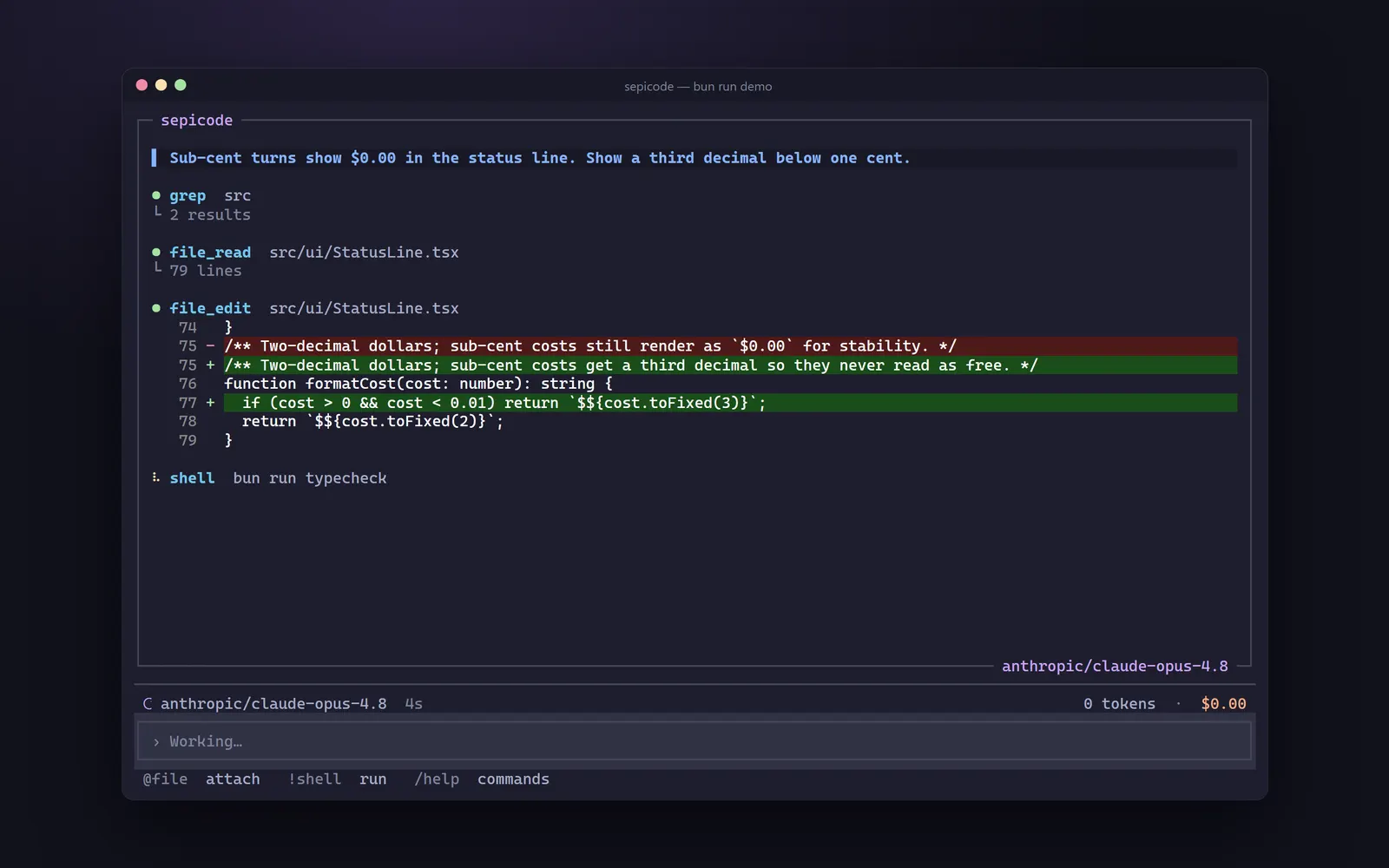 | 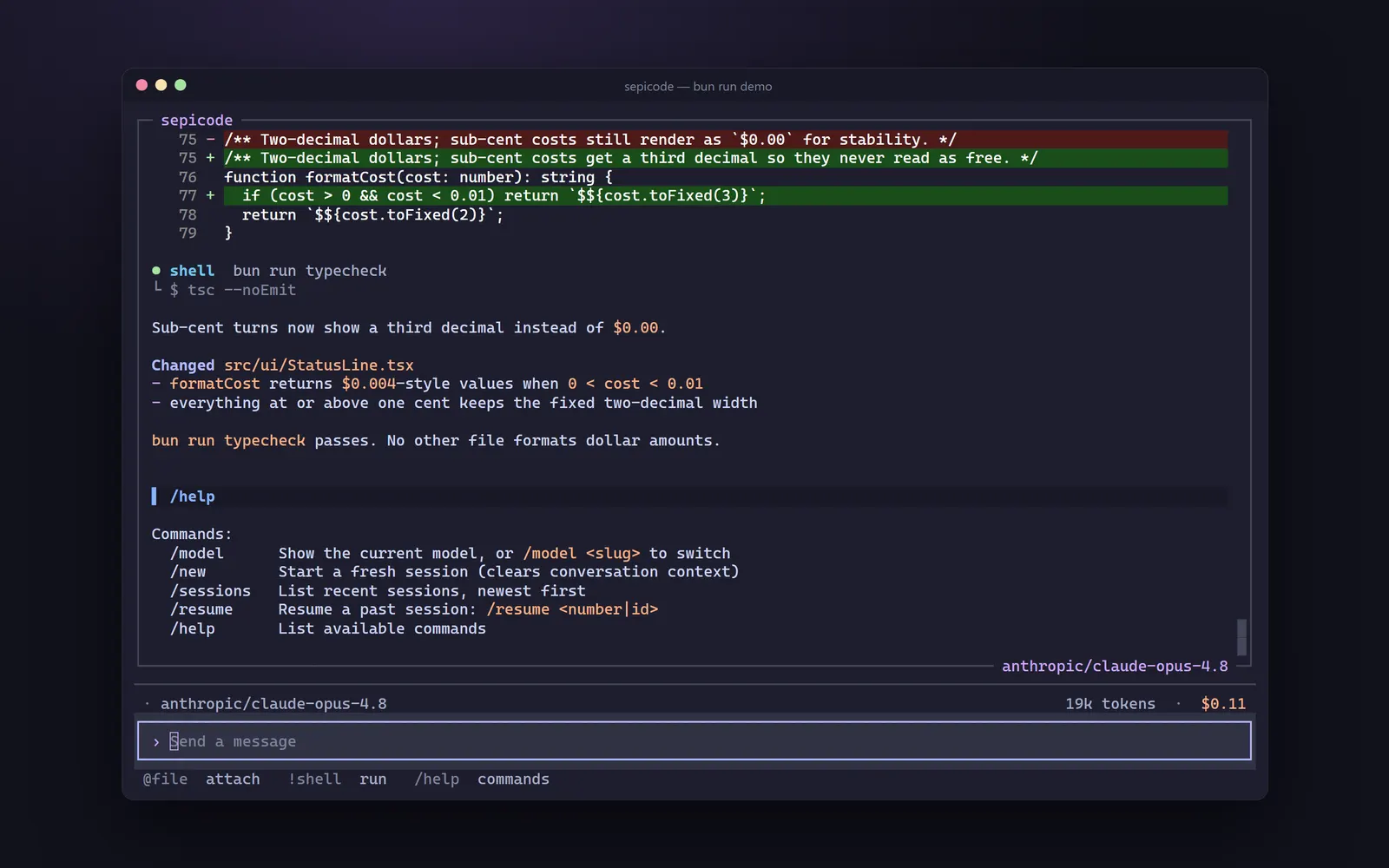 |
| Welcome screen with input shortcuts | A turn in flight: tool calls stream in, elapsed timer ticks | Slash commands go through the real command handler |
Why it’s interesting
- Bounded autonomy. The agent runs full-auto (no approval prompts), so every turn is capped on both step count and spend:
stepCountIs(maxSteps)plusmaxCost(maxCost)(src/agent/runner.ts). - Read-only sub-agent.
sub_agentspawns a child agent with onlyfile_read,glob,grepandlist_dir, and tighter caps (8 steps, $0.25), so delegated investigation cannot modify anything or run away (src/tools/subagent.ts). - Interruptible turns. Esc aborts the in-flight turn through an
AbortSignalpassed to the model call; the shell tool kills the whole process tree on timeout. - Typed event bus. The SDK stream is mapped to a small
AgentEventunion (src/agent/events.ts), so the React UI never touches SDK types. - Persistent sessions. Conversations are stored as JSONL and can be resumed; the last model picked with
/modelsurvives restarts.
Tools
| Tool | What it does |
|---|---|
file_read, file_write, file_edit | Read, create, and patch files (edits render as diffs in the TUI) |
glob, grep, list_dir | Find files, search contents, list directories |
shell | Run a command via cmd.exe on Windows or bash -c elsewhere; combined stdout and stderr, truncated to 2000 lines / 256 KB, 120 s default timeout |
web_search | OpenRouter’s server-side search tool |
sub_agent | Delegate a read-only investigation to a child agent (see above) |
Cost and step caps
| Variable | Default | Scope |
|---|---|---|
SEPICODE_MAX_STEPS | 20 | Tool-call rounds per turn |
SEPICODE_MAX_COST | 1.0 | USD ceiling per turn |
| Sub-agent (fixed in code) | 8 steps, $0.25 | Per sub_agent call |
The status line shows running token and cost totals.
Context compaction
src/harness/compaction.ts implements compaction: once token usage passes 75% of an assumed 200k window, it asks a small model (anthropic/claude-haiku-4.5) to summarize the conversation, and any failure falls back to “don’t compact”. Note: this module is not yet called from the UI or runner, so long sessions are not compacted automatically.
Architecture
flowchart LR
  In[Prompt input<br/>@file, !cmd, /commands] --> H[Harness]
  H --> R[Agent runner<br/>callModel loop]
  R -->|tool calls| T[Tools<br/>file, search, shell, web, sub_agent]
  R -->|stream| E[AgentEvent bus]
  E --> UI[OpenTUI React app]
  R -->|state| S[(JSONL session)]
src/
cli.tsx entry: loads config, wires harness + agent + UI
config.ts env -> Config theme.ts Catppuccin Mocha tokens
agent/ runner.ts (loop, stop conditions), events.ts (stream -> AgentEvent), prompt.ts
tools/ file, search, shell, web, subagent, index (registry, zod schemas)
harness/ session (JSONL), compaction, commands, input, state
ui/ App, MessageList, Message, ToolCall, StatusLine, PromptInputDesign notes: docs/superpowers/specs/2026-06-21-sepicode-coding-agent-tui-design.md.
Tech stack
Bun, TypeScript, React 19, OpenTUI, @openrouter/agent, zod.
Getting started
Requires Bun and an OpenRouter API key.
cp .env.example .env    # then set OPENROUTER_API_KEY
bun install
bun start               # run in a real terminal; it is a full-screen TUI
bun run demo            # offline: real UI, scripted agent, no key or network
scripts/capture-screenshots.cjs regenerates docs/images/ from the demo (see its header for the Playwright / node-pty / xterm.js setup).
Usage:
- Type a request and press Enter.
@path/to/fileinlines a file into the prompt.!cmdruns a shell command directly.- Slash commands:
/model [slug],/new,/sessions,/resume <number|id>,/help. - Ctrl+C exits; Up/Down recall history.
Configuration
All variables are optional except the key. See .env.example.
| Variable | Default |
|---|---|
OPENROUTER_API_KEY | required |
SEPICODE_MODEL | anthropic/claude-opus-4.8 |
SEPICODE_SUBAGENT_MODEL | anthropic/claude-opus-4.8 |
SEPICODE_REASONING_EFFORT | medium (off or none to disable) |
SEPICODE_TEMPERATURE | 0 (used only when reasoning is off) |
SEPICODE_THEME | catppuccin-mocha |
SEPICODE_SESSION_DIR | ~/.sepicode/sessions |
SEPICODE_STATE_FILE | ~/.sepicode/state.json |
Tests
There is no test suite yet. bun run typecheck runs tsc --noEmit.
Because the agent has unrestricted shell and file-write access and no approval gate, run it only in directories you are comfortable letting it modify.
License
MIT, see LICENSE.
Built by Sepehr Radmard · LinkedIn · GitHub · more projects on my profile