 Radmard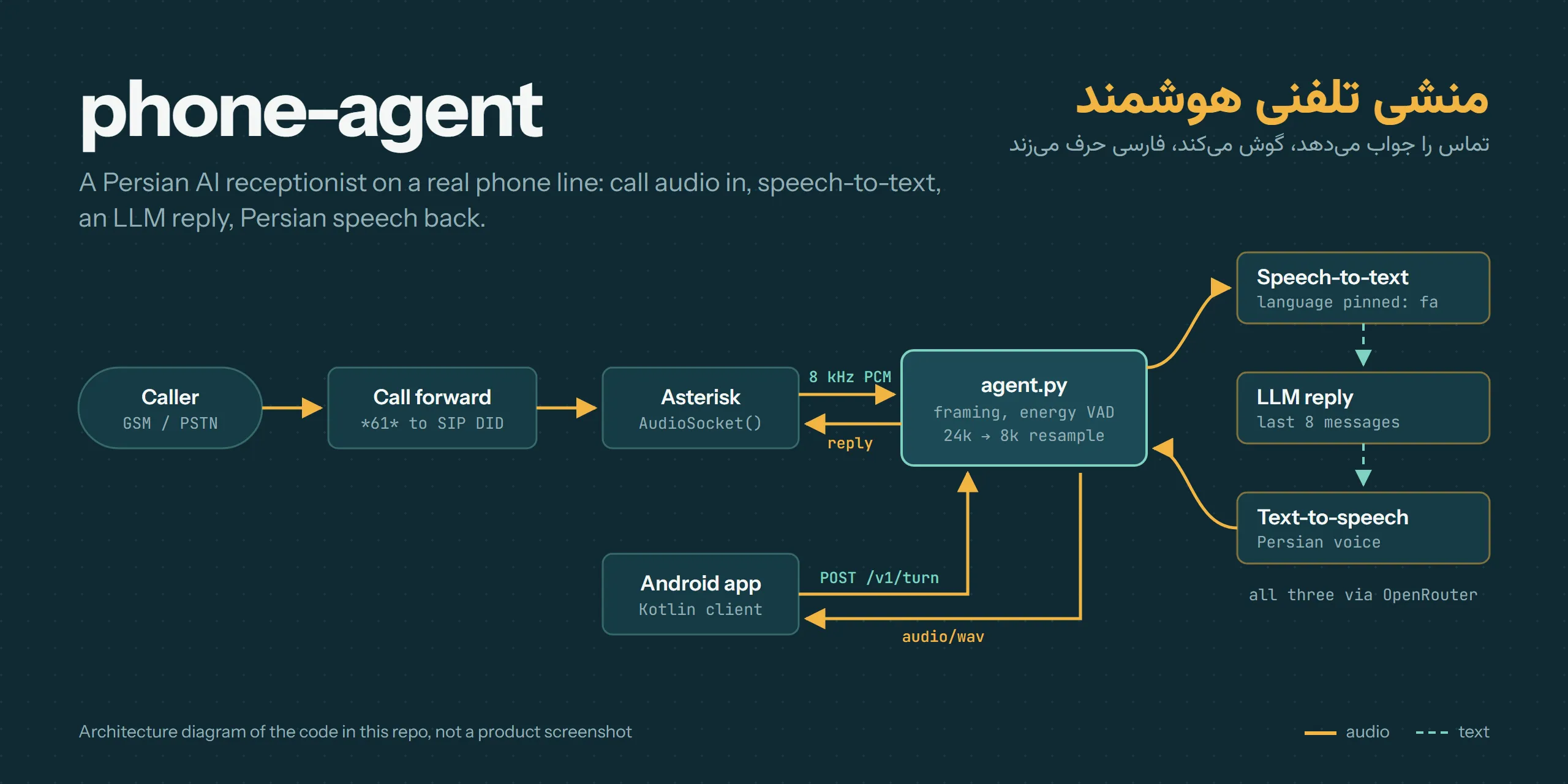
A Persian (Farsi) AI phone receptionist: it answers a real call, listens, replies in natural Persian speech, and keeps short-term context across turns.
Highlights
- Voice loop on a real phone line: Asterisk AudioSocket in, 8 kHz PCM framing and turn-taking by hand, speech back on the call.
- Persian first: STT pinned to
fa, Persian system prompt and fallbacks, Persian TTS voice. - Two delivery paths: SIP/GSM through Asterisk, or an Android default-dialer app that auto-answers and talks to the same HTTP turn API.
- Small and dependency-light: one Python file on stdlib sockets and
http.serverplushttpx; models swap by env var. - Runs offline for a demo:
scripts/demo_call.pydrives the real call loop with stubbed models, no API key needed.
Why it’s interesting
- Real-time voice loop over a telephony protocol: Asterisk streams raw 8 kHz PCM over AudioSocket, and
agent.pyframes/parses it, detects end of speech with a simple energy VAD, then runs STT, LLM and TTS per turn (handle_call,energy_vad_end). - Audio plumbing done by hand: 8 kHz telephone audio is wrapped as WAV for STT, and 24 kHz TTS output (MP3 decoded to PCM) is resampled back to 8 kHz for the line (
resample,_mp3_to_pcm,play_pcm24_as_8k). - Persian-first: STT is pinned to
fawith a Persian context prompt, the system prompt and fallback phrases are Persian, and TTS uses a Persian language boost.check.pyround-trips TTS into STT and asserts the Persian greeting word comes back. - A second delivery path for phones without a SIP trunk: a small HTTP API (
/v1/turn,/v1/greeting) and an Android app (Kotlin) that auto-answers and talks to it, plus ausb_bridge.pyexperiment that records the call over adb. - Everything model-related goes through one OpenRouter key, so STT, LLM and TTS models are swappable with env vars.
Architecture
flowchart LR
    Caller((Caller)) --> PSTN[SIP / GSM] --> AST[Asterisk]
    AST -- AudioSocket 8k PCM --> AG[agent.py]
    AND[Android app] -- HTTP /v1/turn WAV --> AG
    AG --> STT[OpenRouter STT]
    STT --> LLM[OpenRouter LLM]
    LLM --> TTS[OpenRouter TTS]
    TTS --> AG
    AG -- audio reply --> AST
    AG -- audio/wav --> AND
agent.py socket listens for AudioSocket connections from Asterisk (see asterisk-extensions.conf.example). agent.py serve runs both the AudioSocket listener and the HTTP API used by the Android client. Per-call history keeps the last 8 messages.
Tech stack
Python 3.12+ (stdlib sockets and http.server, httpx), OpenRouter (speech-to-text, chat, text-to-speech), Asterisk AudioSocket, Android (Kotlin, Gradle), pm2 (ecosystem.config.cjs).
Key techniques
- AudioSocket frame protocol (type byte, 16-bit length, payload):
_read_frame,_send_frameinagent.py. - Energy-based voice activity detection for turn taking:
energy_vad_end. - Stateless-ish HTTP turn API with a session header for clients:
PhoneHttpinagent.py. - Android default-dialer / in-call service that auto-answers and plays TTS through the speaker:
android/app/src/main/java/dev/sepehr/phoneagent/. - Call-forwarding setup for a GSM SIM:
CALL_FORWARDING.md.
Getting started
Try the call loop offline first (no key, no Asterisk; STT/LLM/TTS stubbed with demo data):
uv sync
uv run python scripts/demo_call.py
Then with a real key:
cp .env.example .env        # set OPENROUTER_API_KEY
uv sync
uv run python agent.py greet                       # writes the greeting wav
uv run python agent.py reply 'سلام، پیک هستم'       # one text turn, prints/saves the reply
uv run python agent.py serve                       # AudioSocket :9092 + HTTP :9093
Point Asterisk at the host using asterisk-extensions.conf.example. For the Android client, see android/INSTALL.md and set the server URL in the app.
Tests
There is no unit test suite. uv run python scripts/demo_call.py is an offline check of the AudioSocket framing, VAD, resampling and HTTP turn API (it asserts frame sizes, sample rates and that turn 2 sees turn 1’s history). uv run python check.py is a live smoke test (TTS then STT, must contain “سلام”) and needs a valid API key.
Screenshots
The project has no web UI, so the images here are the architecture diagram at the top and real terminal output, not app screenshots.
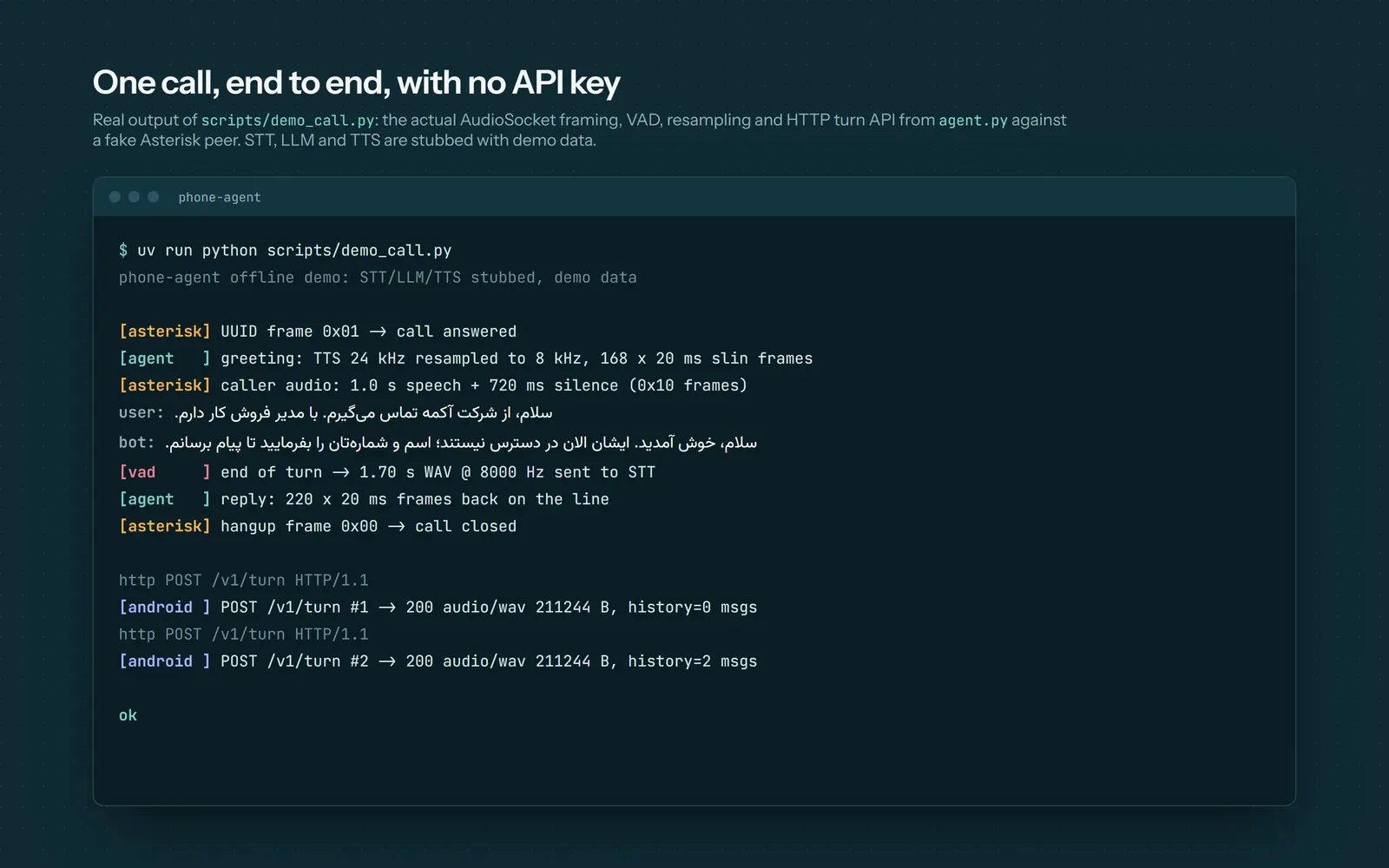
Real output of scripts/demo_call.py: one AudioSocket call and two HTTP turns (demo data, models stubbed).
The HTML sources for both images are in docs/diagrams/.
License
MIT
Built by Sepehr Radmard · LinkedIn · GitHub · more projects on my profile