 Radmard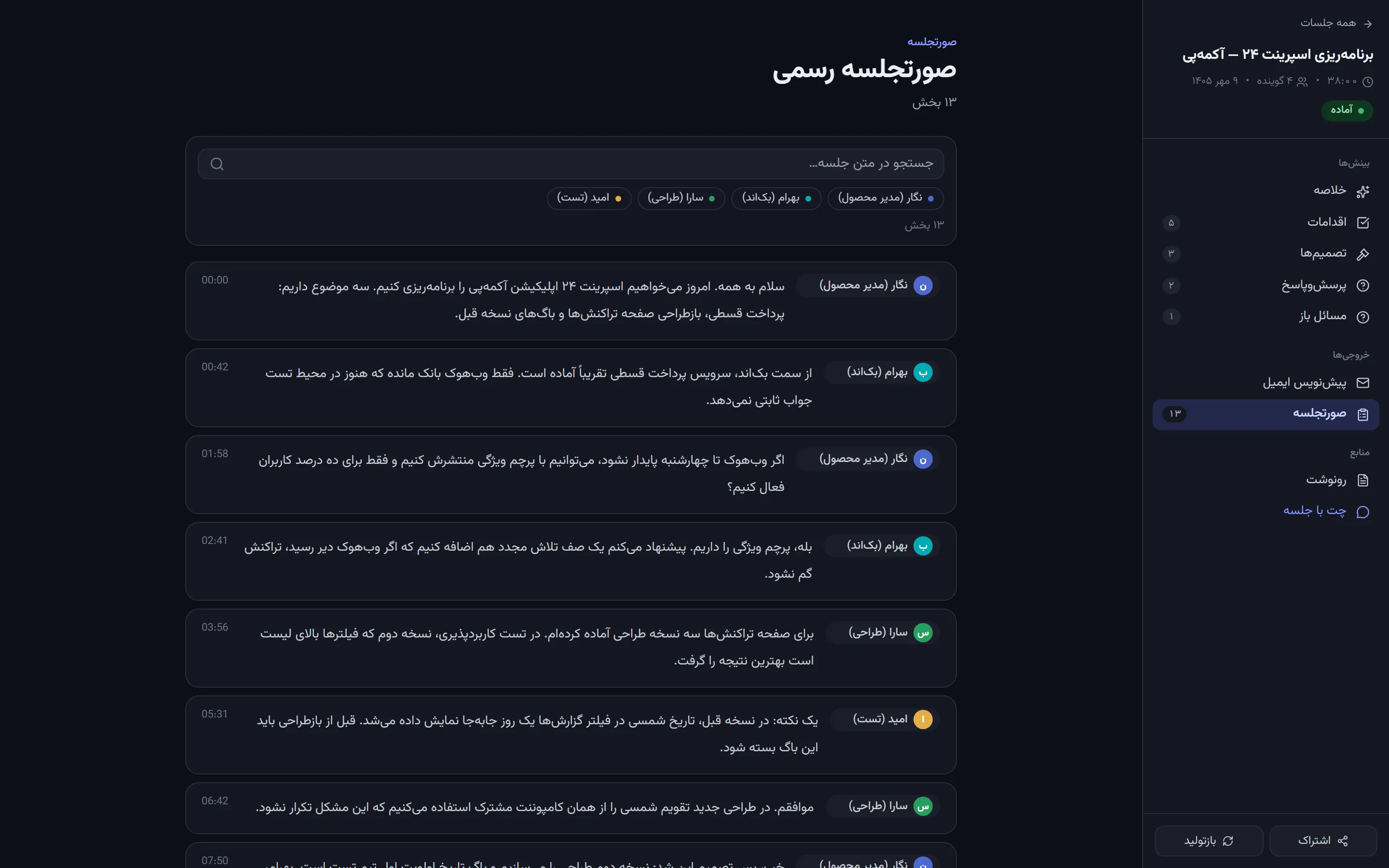
Minutes: speaker-attributed, time-stamped segments with search and per-speaker filters (demo data).
Drop in a Persian meeting recording; get back who said what, the decisions, the action items, and a follow-up email.
Persian-first AI meeting recorder: record or upload a meeting, get a speaker-diarized transcript, and turn it into structured minutes, action items, decisions, Q&A and a follow-up email draft.
FastAPI, SQLAlchemy 2.0 (async), Next.js 16, ElevenLabs Scribe v2, OpenRouter (Gemini 3 Flash Preview).
Highlights
- Long recordings are transcribed in parallel chunks, and speakers are stitched back together across chunk seams.
- The LLM returns summaries through a strict JSON schema, so the UI always gets well-formed action items, decisions and Q&A.
- Speaker-attributed minutes come from the diarized words, not from the model, so who-said-what can’t be hallucinated.
- Persian end to end: RTL UI, Jalali dates, Persian digits, per-series glossaries fed to the ASR as keyterms.
- Three ways in: file upload, microphone, or a browser tab (Meet, Zoom Web, Teams Web), with live captions while recording.
- Per-meeting chat over the transcript, streamed over SSE. Light and dark themes follow the OS.
Screenshots
All screenshots show the real UI running on a seeded, fictional workspace (demo data: made-up team “Acme Pay”, made-up speakers; no LLM or ASR calls).
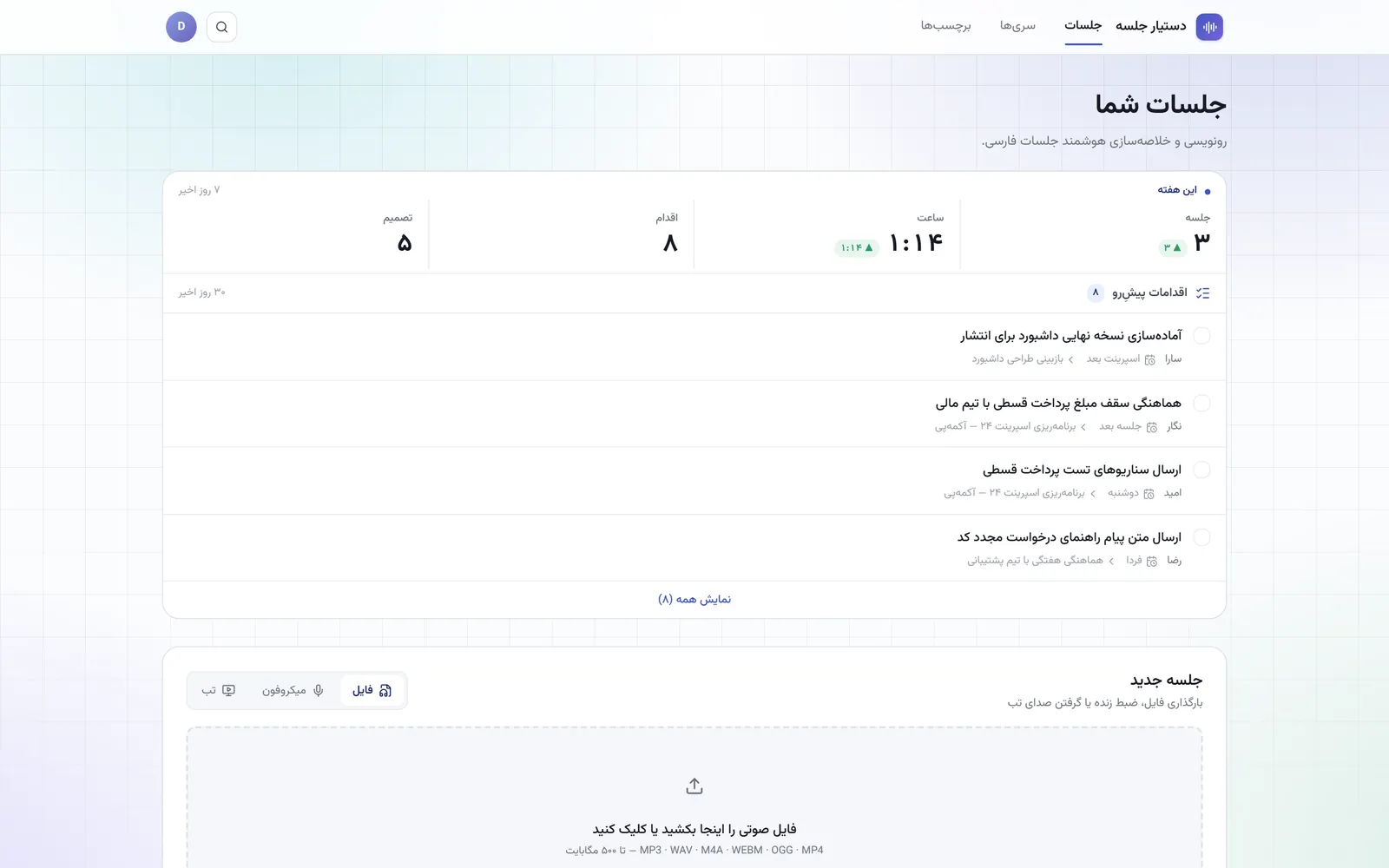 | 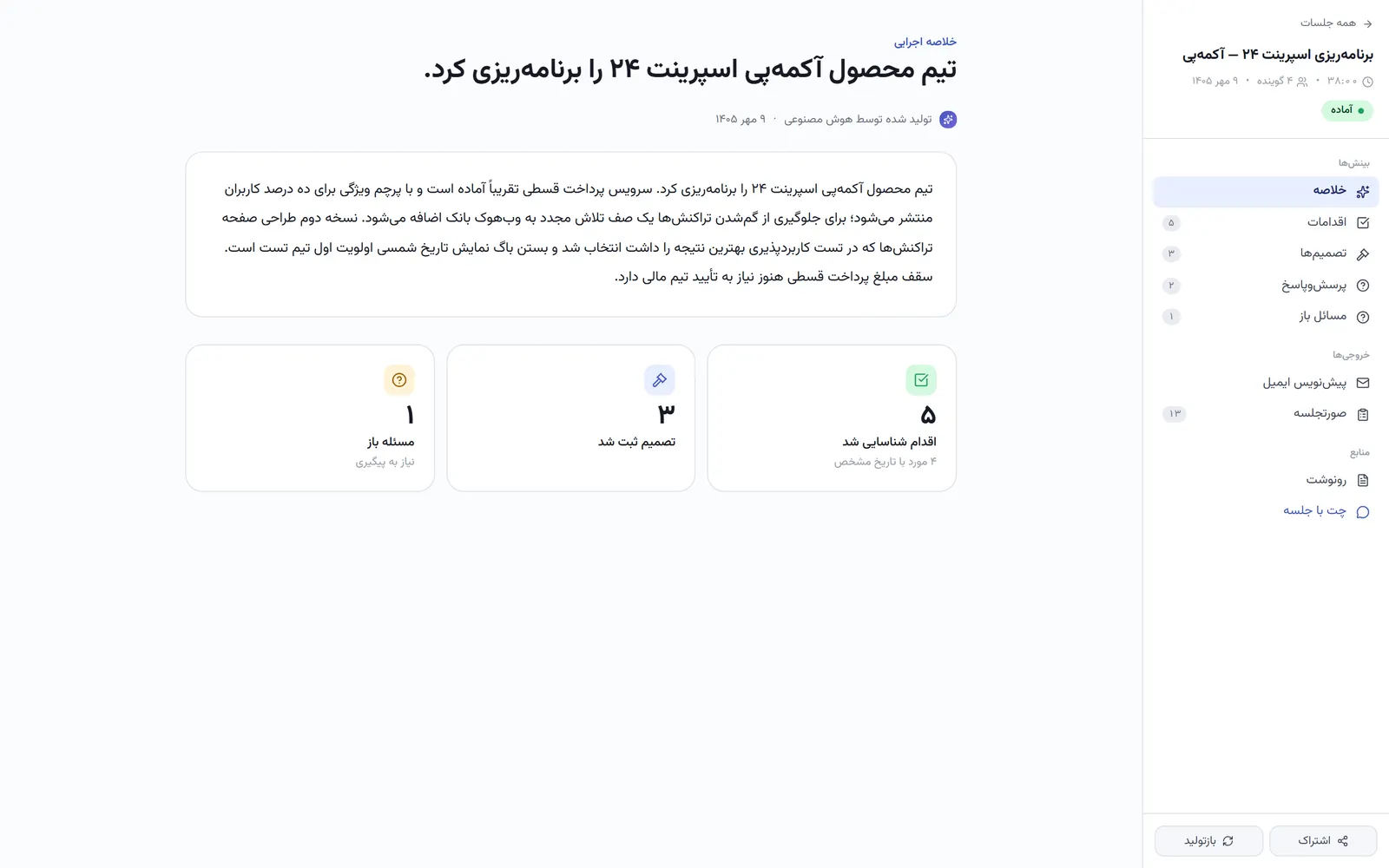 |
| Dashboard. Weekly stats and open action items pulled from every meeting (demo data). | Executive summary. One-paragraph summary plus counts of actions, decisions and open questions (demo data). |
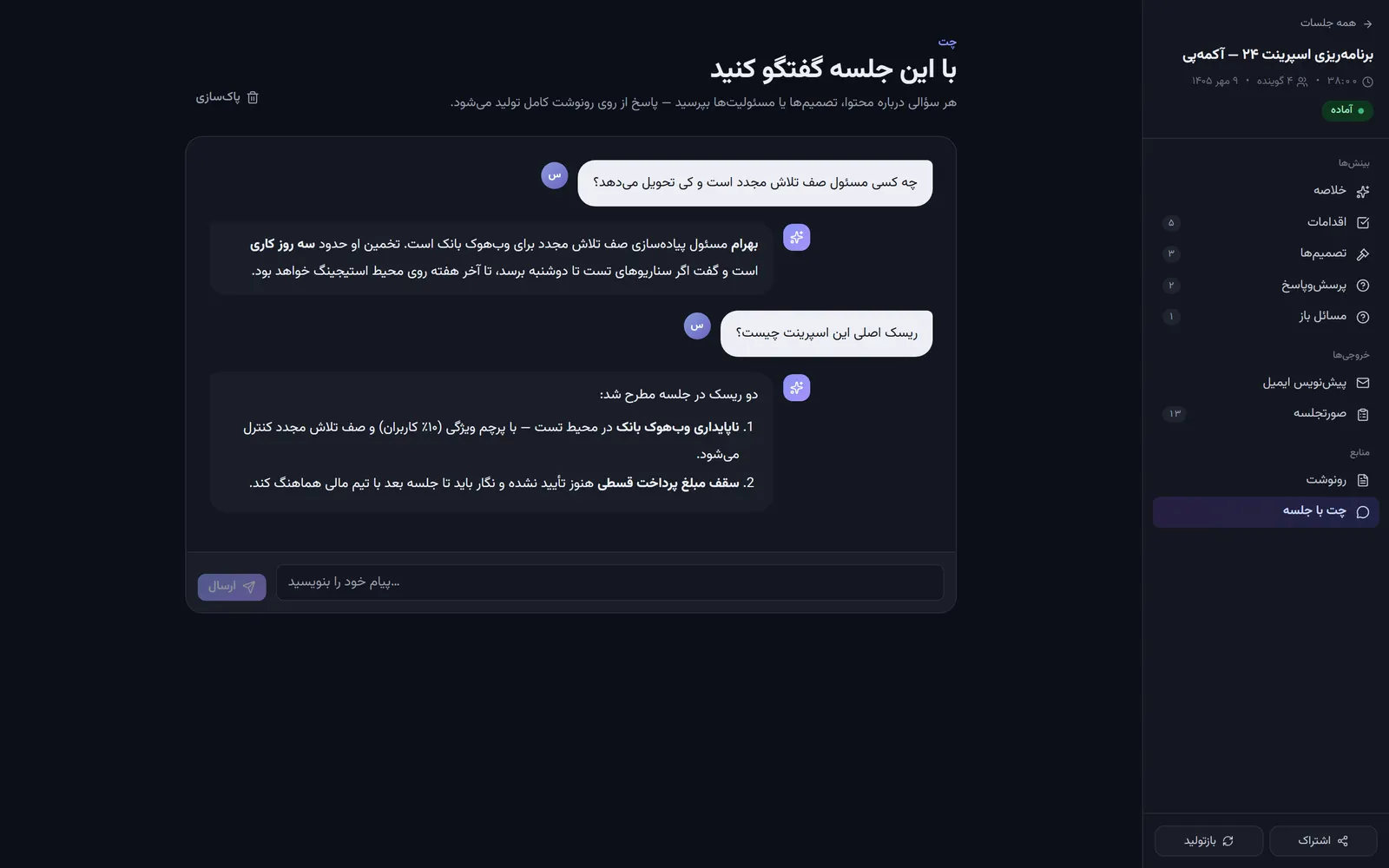 | 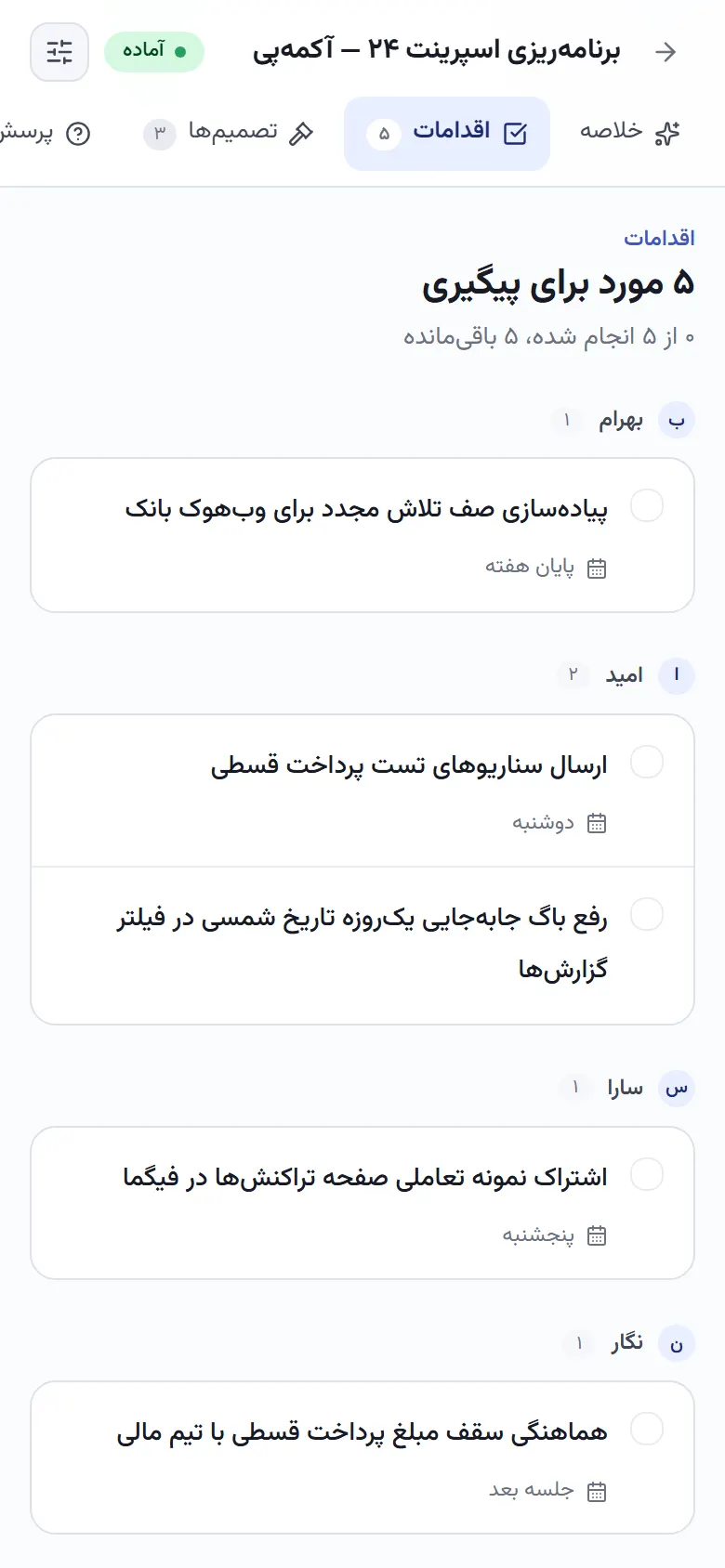 |
| Chat with the meeting. Answers grounded in the transcript and artifacts (demo data). | Action items on mobile, grouped by owner (demo data). |
Why it’s interesting
- Chunked diarization with speaker stitching. Long recordings are split into overlapping chunks that are sent to Scribe in parallel. Each chunk numbers its speakers independently, so
_stitchintranscription.pyrebases timestamps, maps local speaker ids to global ones by voting on the overlap window, and de-duplicates words at a midpoint boundary. - Strict structured output. Summaries are requested from the LLM with
response_format: json_schemaandstrict: true(summarizer.py), then validated, so the UI always receives well-formed action items, decisions and Q&A. - Facts from data, prose from the LLM. Speaker-attributed minutes are built server-side from the diarized words, not generated by the model, so attribution cannot be hallucinated.
- Persian end to end. Transcription defaults to
fas, the UI handles RTL text (frontend/lib/rtl.ts), and per-series glossaries are passed to Scribe as keyterms to improve names and jargon. - Live captions plus an authoritative pass. Browser mic or tab audio is streamed to Scribe Realtime over WebSocket for display-only captions, while the stop-time batch diarization is what gets saved.
Architecture
flowchart LR
    U[Upload / mic / tab capture] --> API[FastAPI]
    U -. PCM 16k .-> RT[Scribe v2 Realtime: live captions]
    API --> P[Pipeline background task]
    P --> S[Split into overlapping chunks]
    S --> T[Scribe v2 batch + diarization, parallel]
    T --> ST[Stitch speakers across chunks]
    ST --> M[Minutes built from diarized words]
    ST --> L[LLM via OpenRouter, strict json_schema]
    L --> A[Summary, actions, decisions, Q&A, email]
    M --> DB[(SQLite)]
    A --> DB
    DB --> FE[Next.js UI + per-meeting SSE chat]
Meeting state machine: uploaded -> transcribing -> summarizing -> done (or failed). The pipeline runs as a FastAPI BackgroundTask, is idempotent, and can be cancelled mid-run.
Features
- Three ingest modes: file upload, microphone, or another browser tab (Meet, Zoom Web, Teams Web) via
getDisplayMedia. - Seven artifacts: executive summary, action items, decisions, minutes, Q&A, open questions, follow-up email (formal or casual).
- Series for recurring meetings: shared glossary, remembered speaker names, email tone. A fuzzy matcher (
rapidfuzz) suggests a series on upload. - Tags and search to filter the meeting list.
- Per-meeting chat, streamed over SSE, grounded in the transcript and all artifacts.
- OIDC (Keycloak-style) login handled by the backend, session cookie, login rate limiting.
Tech stack
Backend: Python 3.12, FastAPI, SQLAlchemy 2.0 async, Alembic, SQLite, uv.
Frontend: Next.js 16 (App Router), Tailwind 4, shadcn/ui, pnpm.
AI: ElevenLabs Scribe v2 (batch and realtime), OpenRouter.
Key techniques
| Technique | Where |
|---|---|
| Parallel chunked transcription and speaker stitching | backend/app/services/transcription.py |
| Strict JSON-schema LLM output | backend/app/services/summarizer.py, backend/app/prompts/summary_system.txt |
| Pipeline state machine, cancellation | backend/app/services/pipeline.py |
| Glossary keyterms for ASR | backend/app/services/glossary.py |
| Speaker-name memory, series matching | backend/app/services/speakers.py, series_match.py |
| Realtime token minting, browser WebSocket client | backend/app/services/realtime_token.py, frontend/lib/scribe-realtime.ts |
| SSE chat over meeting context | backend/app/services/chat.py |
Getting started
Requirements: Python 3.12 with uv, Node 22 with pnpm, ffmpeg.
# backend
cd backend
cp .env.example .env     # set ELEVENLABS_API_KEY, OPENROUTER_API_KEY, SESSION_SECRET (>=32 chars)
uv sync
uv run alembic upgrade head
uv run uvicorn app.main:app --host 127.0.0.1 --port 8000

# frontend (second shell)
cd frontend
cp .env.example .env.local
pnpm install
pnpm dev                 # http://localhost:3000
Login uses OIDC. Fill the OIDC_* variables in backend/.env with a confidential client from your identity provider (see comments in .env.example). Mic and tab capture need HTTPS or localhost.
Demo mode (no API keys, no identity provider)
scripts/seed_demo.py fills a throwaway SQLite database with a fictional Persian workspace and prints a signed session cookie, so the UI can be browsed without OIDC. Nothing in it calls ElevenLabs or OpenRouter.
cd backend
export DATABASE_URL=sqlite+aiosqlite:///./demo.db STORAGE_DIR=./storage-demo ALLOWED_ORIGIN=http://127.0.0.1:4140
PYTHONPATH=. uv run python ../scripts/seed_demo.py     # recreates tables; last line: ma_session=<cookie>
uv run uvicorn app.main:app --host 127.0.0.1 --port 4141

cd ../frontend
NEXT_PUBLIC_API_BASE=http://127.0.0.1:4141/api pnpm build
pnpm exec next start -H 127.0.0.1 -p 4140
Set the printed ma_session cookie for 127.0.0.1 in the browser, or regenerate the README screenshots with node scripts/capture-screenshots.cjs http://127.0.0.1:4140 <cookie> (needs Playwright on NODE_PATH).
For a Linux server, bootstrap.sh and setup.sh install prerequisites and run both apps under pm2 (see INSTALL.md); deploy/ has template pm2, nginx and Caddy configs with placeholder hosts.
Tests
cd backend && uv run pytest -q          # one live-Scribe smoke test is skipped without a key
cd frontend && pnpm lint && pnpm exec tsc --noEmit && pnpm build
GitHub Actions (.github/workflows/ci.yml) runs the backend tests and the frontend lint, typecheck and build.
Limits
- Persian only by default (
language_code=fas); change it intranscription.pyfor another language. - No live diarization: speaker labels come from the batch pass after stop.
- Uploads are single blobs capped at 500 MB; no background worker queue.
- Audio is kept on disk with no cleanup job.
- Chrome/Edge fully supported; Firefox tab audio is partial; Safari untested.
License
MIT, see LICENSE.
Built by Sepehr Radmard · LinkedIn · GitHub · more projects on my profile