 Radmard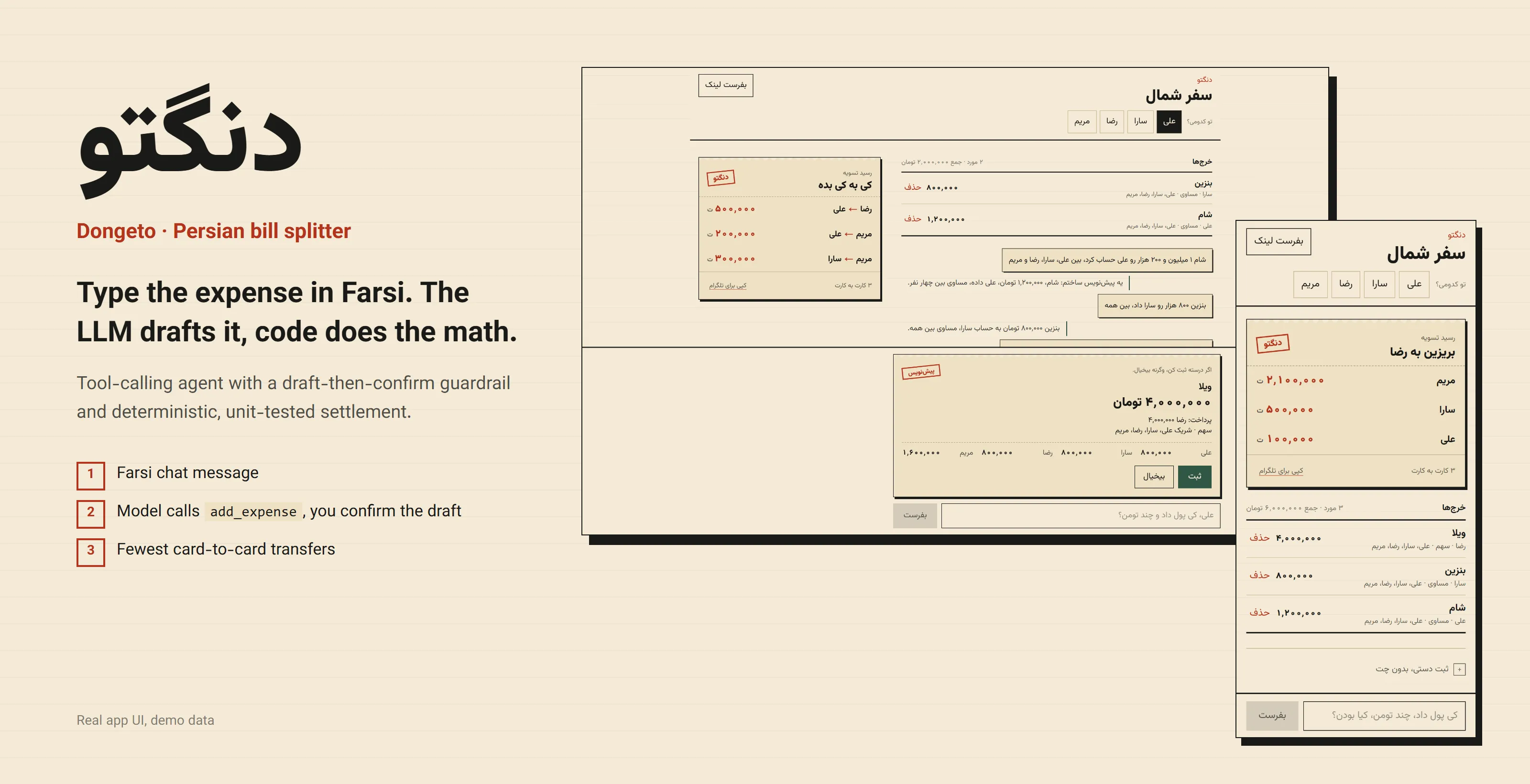
Type the expense in Farsi. The LLM drafts it, code does the math.
A Persian bill splitter: describe an expense in Farsi, the LLM drafts it, you confirm, and deterministic code works out who pays whom with the fewest transfers.
Highlights
- LLM as a parser, not a calculator: the model only calls tools; all money math is integer toman in unit-tested code.
- Human-in-the-loop: every AI-built expense is a draft card, with each person’s share already computed by the split engine, until you press ثبت.
- Self-correcting tool loop: tool errors go back to the model, up to 8 steps.
- Persian-first UI: RTL, Vazirmatn, Persian digits,
۴۵۰ هزار/4.5 میلیونparsing, a “carbon copy” dark mode. - Zero setup: no accounts, and a PGlite file DB when no Postgres is configured.
Why it’s interesting
- The model never does math. It only calls tools; amounts are integer toman, and splitting and settlement live in plain, unit-tested code (
lib/split.ts,lib/settle.ts). - Draft-then-confirm. The
add_expensetool only builds and validates a draft (amount, split type, member names). Nothing is saved until the user confirms the card in the UI. - Tool-calling loop with feedback.
runChatinlib/openrouter.tsruns up to 8 steps; tool errors (for example an unknown member name) are returned to the model as tool results so it can correct itself, e.g. calladd_memberfirst. - Persian-first. Farsi system prompt and tool descriptions, RTL UI (Vazirmatn), Persian digit and amount parsing (
۴۵۰ هزار,4.5 میلیون) inlib/money.ts, and a Telegram-ready settlement text. - No accounts. A group is a secret URL; people in it don’t need to open the site.
Example
Input (chat, Farsi):
شام ۱ میلیون و ۲۰۰ هزار رو علی حساب کرد، بین علی، سارا، رضا و مریمThe model calls add_expense with amount_toman: 1200000, split_type: "equal", payer علی, and four shares of weight 1. A draft card appears; after you confirm, the engine settles (each share is 300,000 toman):
سارا ← علی    ۳۰۰٬۰۰۰ تومان
رضا ← علی    ۳۰۰٬۰۰۰ تومان
مریم ← علی   ۳۰۰٬۰۰۰ تومان
(Illustrative; the debtor is on the right, the arrow points toward the payee.) With many expenses, the greedy netting in lib/settle.ts produces at most n-1 transfers.
Architecture
flowchart LR
  U[User, Farsi text] --> C[POST /api/g/token/chat]
  C --> L[runChat: tool loop, max 8 steps]
  L <--> M[OpenRouter model]
  L -->|add_expense| D[buildDraft: validate]
  D --> UI[Draft card in UI]
  UI -->|user confirms| P[(Postgres / PGlite)]
  P --> S[settle.ts: net balances + greedy transfers]
  S --> R[Settlement slips / Telegram text]
The chat route is rate limited (in-memory, per group token). Tools: list_group, add_member, add_expense, explain_settlement.
Tech stack
Next.js 16 (App Router), React 19, Tailwind 4, Drizzle ORM with PGlite (file DB) or Postgres, OpenRouter via the openai SDK, tsx --test for tests.
Key techniques
- Function calling with bounded steps and error feedback:
lib/openrouter.ts - Human-in-the-loop guardrail:
buildDraftvalidation plus the confirm UI (components/ConfirmDraft.tsx) - Split types (equal, exact, percent, shares):
lib/split.ts - Minimum-ish transfer settlement:
lib/settle.ts - Persian amount parsing and formatting:
lib/money.ts
Getting started
npm install
cp .env.example .env     # set OPENROUTER_API_KEY for chat
npm run dev
Open http://localhost:3000. The manual expense form works without an API key. With DATABASE_URL empty the app uses a PGlite file DB under data/.
| Variable | Role |
|---|---|
OPENROUTER_API_KEY | chat |
OPENROUTER_MODEL | default google/gemini-2.5-flash |
OPENROUTER_HTTP_REFERER | OpenRouter ranking header |
DATABASE_URL | empty = PGlite; postgres://... = Postgres |
POSTGRES_PASSWORD | docker-compose only, default change-me |
Docker (Postgres + app): docker compose up --build -d. Set a real POSTGRES_PASSWORD in .env for anything beyond local use.
Tests
npm testCovers money parsing/formatting, the four split types, and settlement (lib/*.test.ts). The LLM path (runChat, buildDraft) is not covered by tests yet.
Screenshots
All screenshots show the real app with demo data (fictional names). The chat reply is mocked in the capture script since no API key is used; group creation, confirm, split and settlement run through the real app and DB.
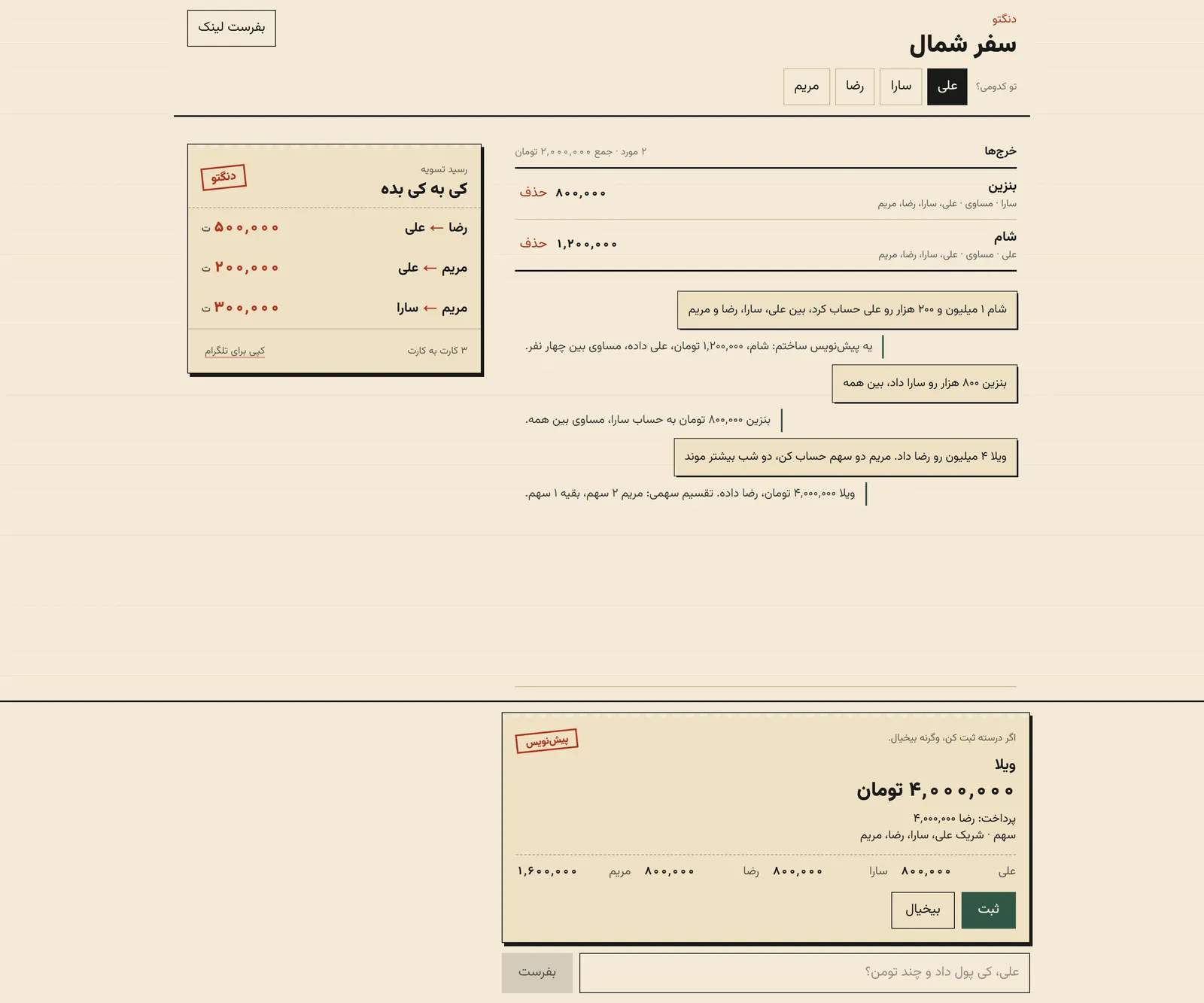 | 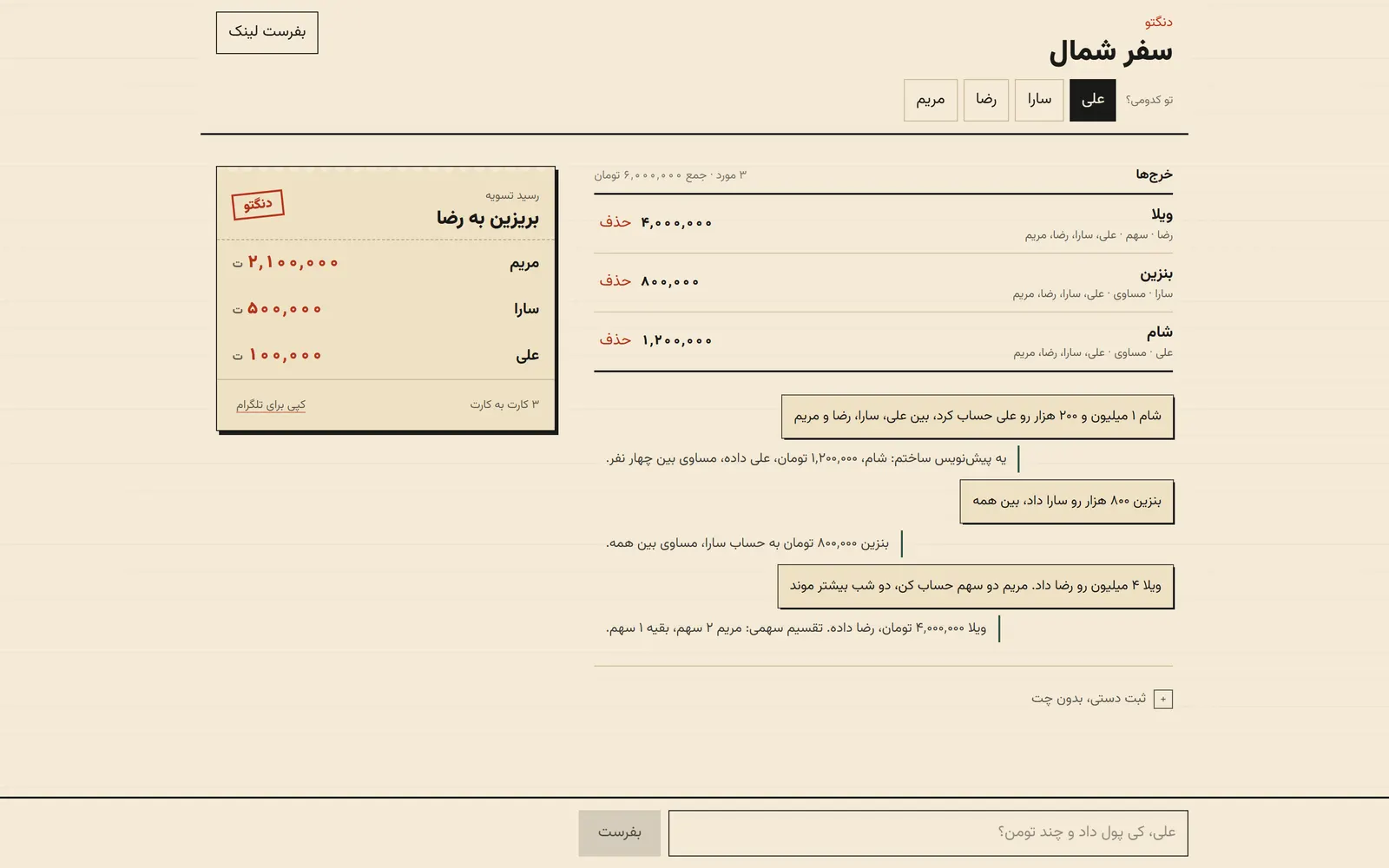 |
| Farsi message becomes a draft card with per-person shares; nothing is saved until you confirm. | After three confirmed expenses: the settlement slip and the expense list. |
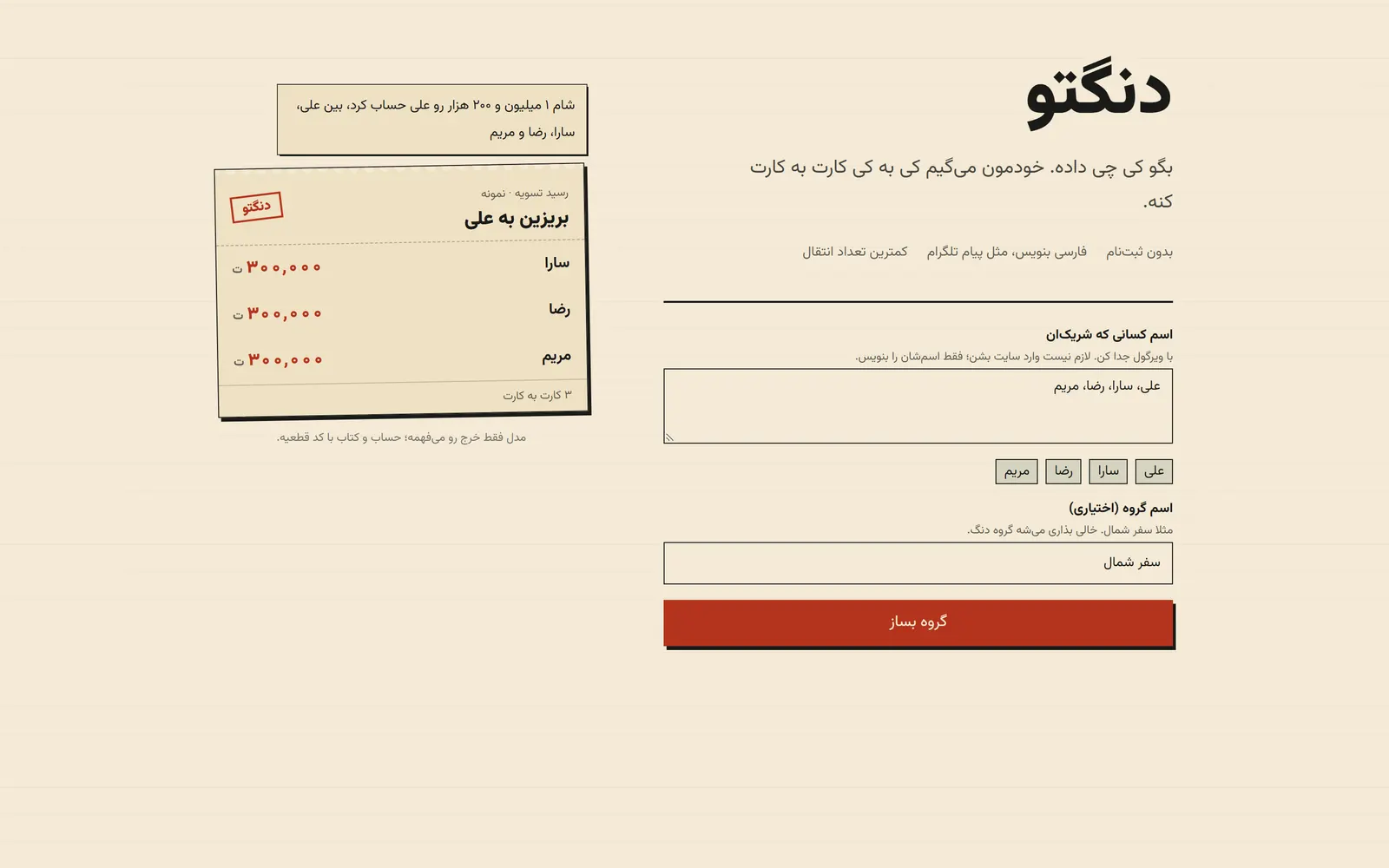 | 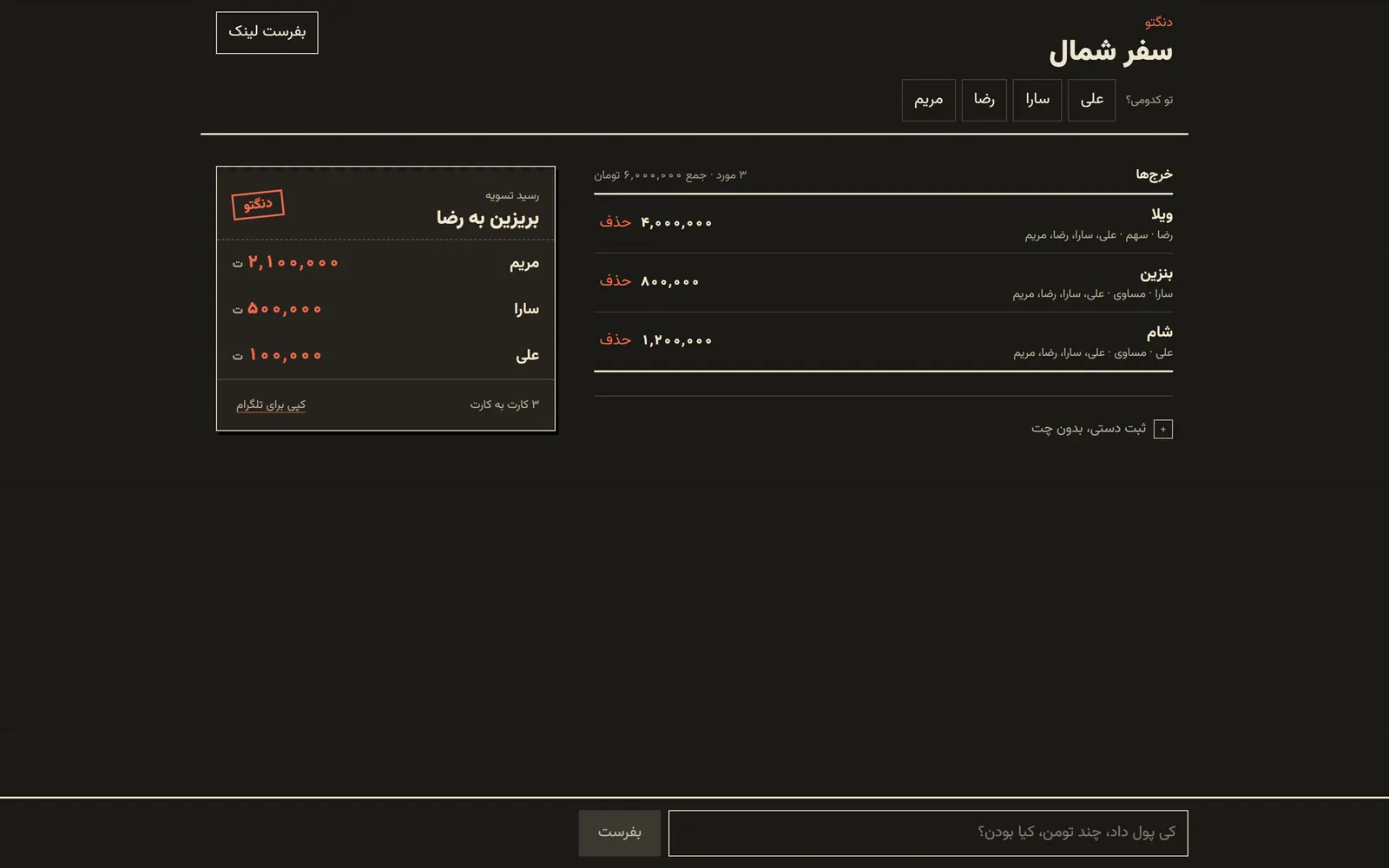 |
| Create a group from a list of names; no sign-up. | Dark mode (“carbon copy”). |
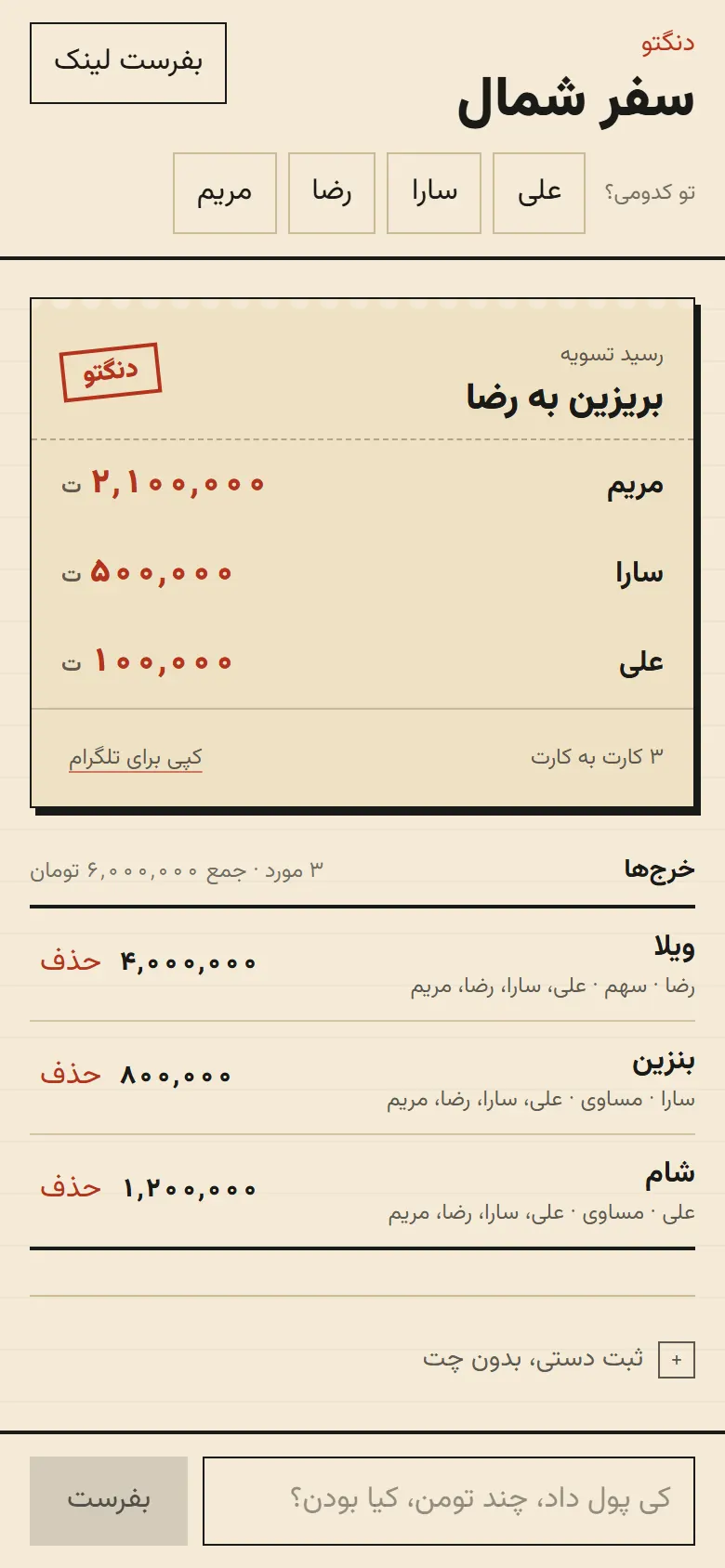
To regenerate: run npm run dev -- -p 4230 -H 127.0.0.1, then node scripts/capture-screenshots.cjs (needs playwright resolvable, e.g. via NODE_PATH). hero.png is a banner composed from chat-draft.png and mobile.png.
Not in v1
Auth, OTP, Telegram bot, receipt OCR, real payments, multi-currency.
License
MIT
Built by Sepehr Radmard · LinkedIn · GitHub · more projects on my profile