 Radmard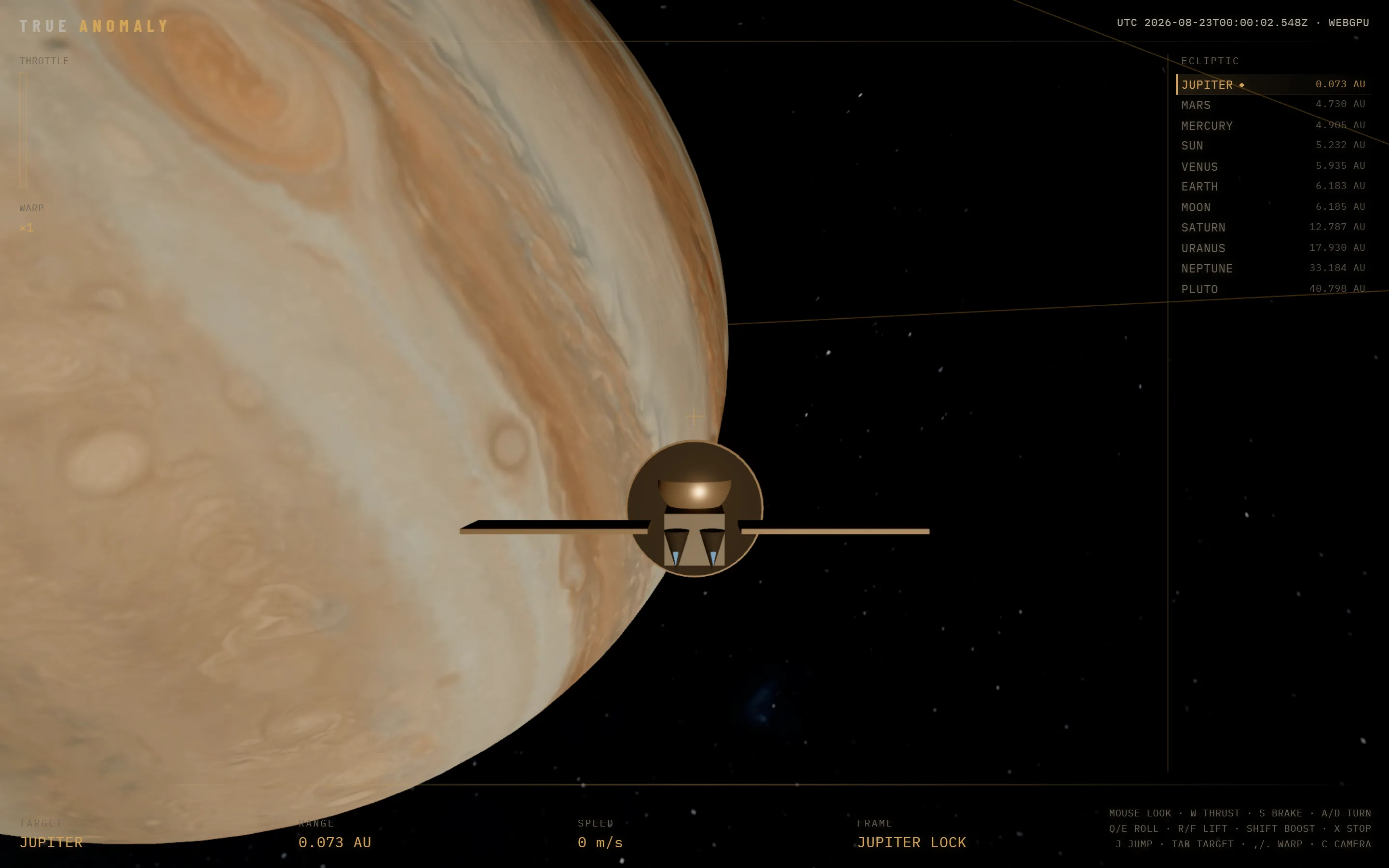
Fly a 6DOF probe through a real-scale solar system in the browser, with every planet placed from NASA/JPL Horizons data.
Custom Three.js WebGPU engine, planet positions from NASA/JPL Horizons, propagated with a Kepler solver. This is a non-AI side project: graphics, orbital mechanics and a small game loop.
Highlights
- Real ephemeris, baked offline. Horizons state vectors are converted to orbital elements and propagated in the browser with a Newton-iteration Kepler solver.
- True-kilometre simulation. Physics runs in km and km/s; only the renderer scales, so the HUD reports real AU and km.
- WebGPU first. Three.js
WebGPURendererwith AgX tone mapping and a post-processing pass, falling back to WebGL when WebGPU is unavailable. - Flight model. 6DOF controls, boost, autopilot jump to any body, auto reference-frame lock and time warp up to x100,000.
- Instrument HUD. Throttle tape, live UTC from the sim epoch, target range and speed, and a body list sorted by distance.
Screenshots
All shots are the real app running in Chrome with WebGPU. The ship was placed with scripts/capture-screenshots.cjs rather than flown there by hand; planet positions are the baked Horizons catalog.
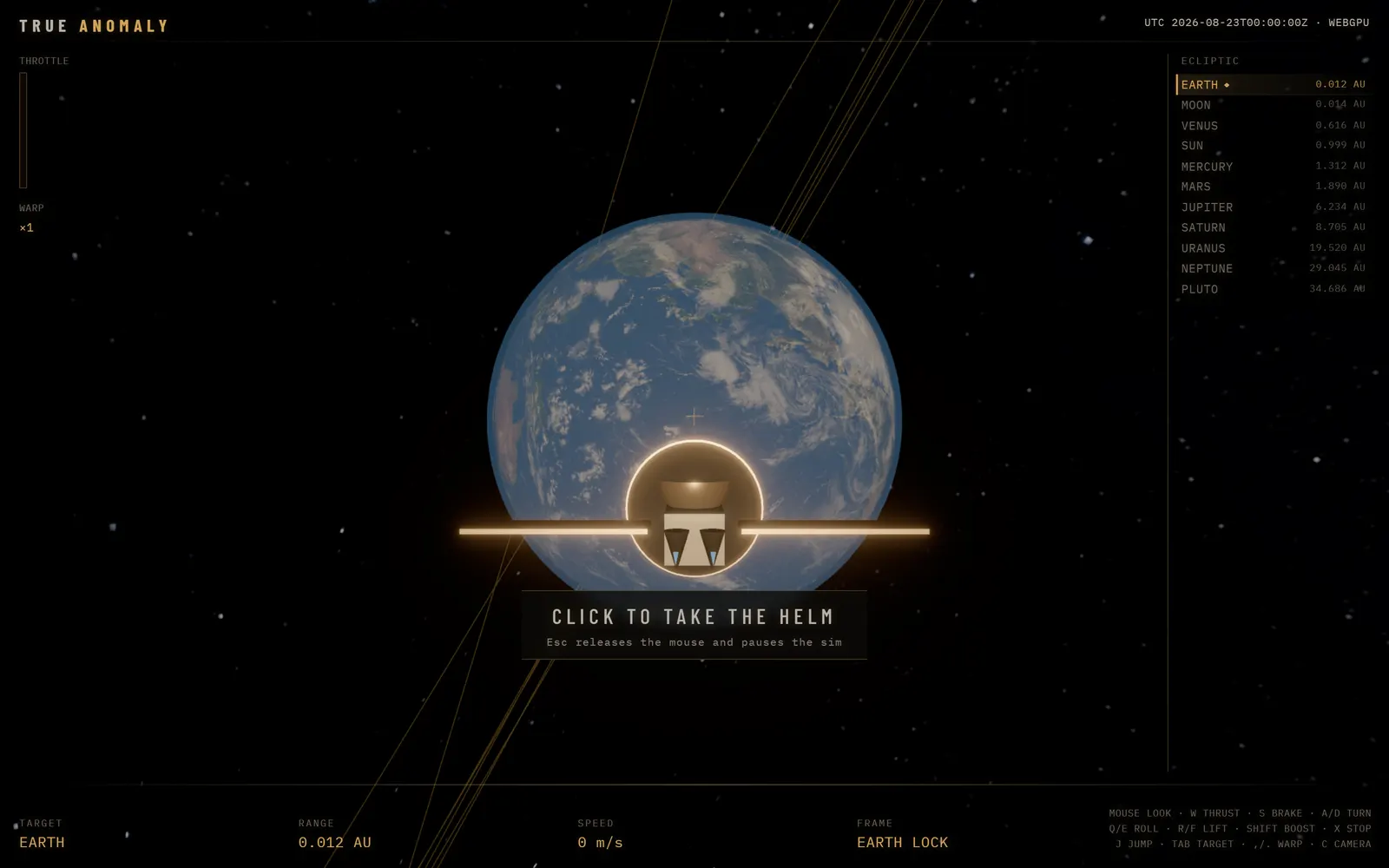 | 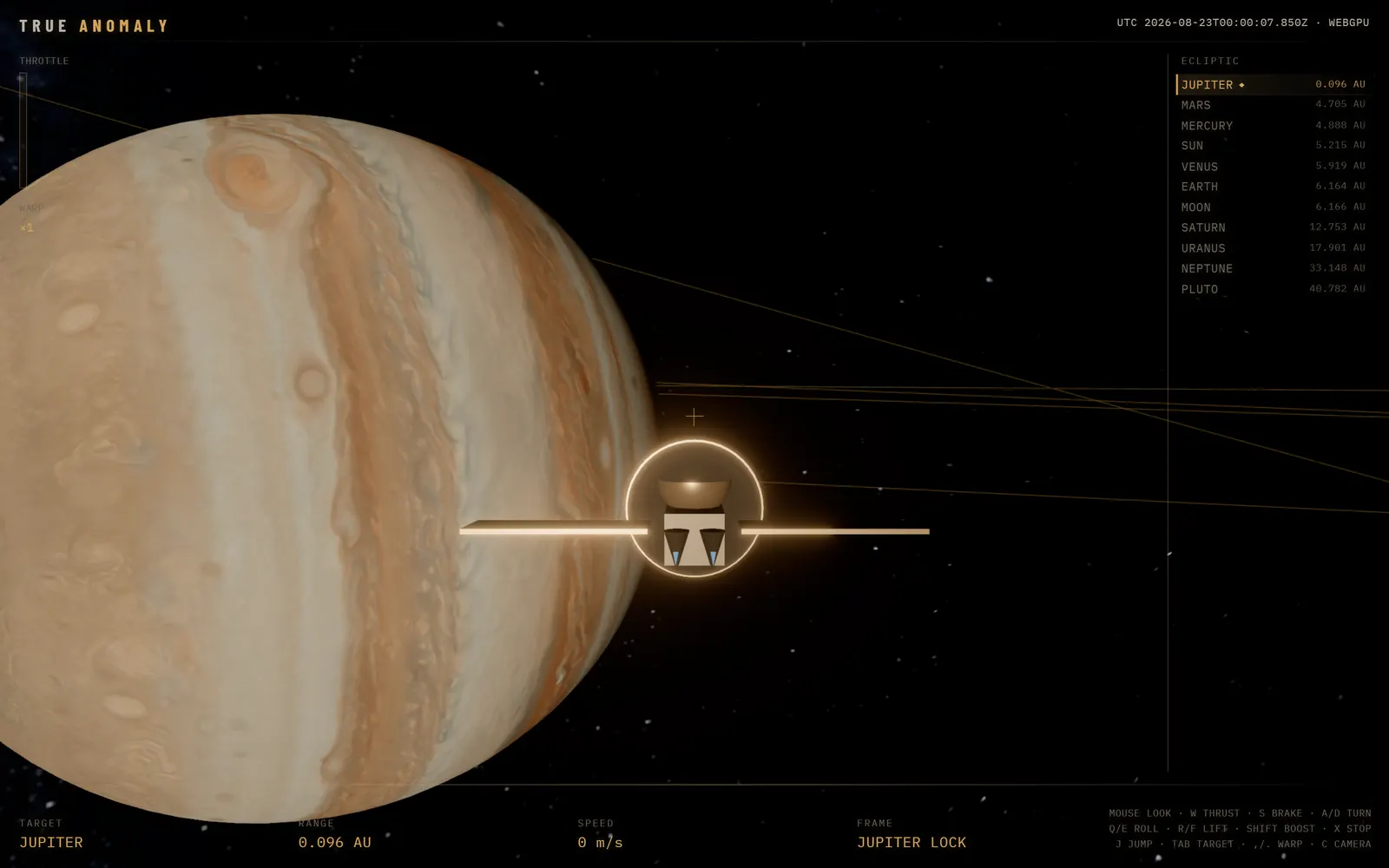 |
| Spawn point near Earth, before the mouse is captured | Jupiter flyby, frame locked to Jupiter |
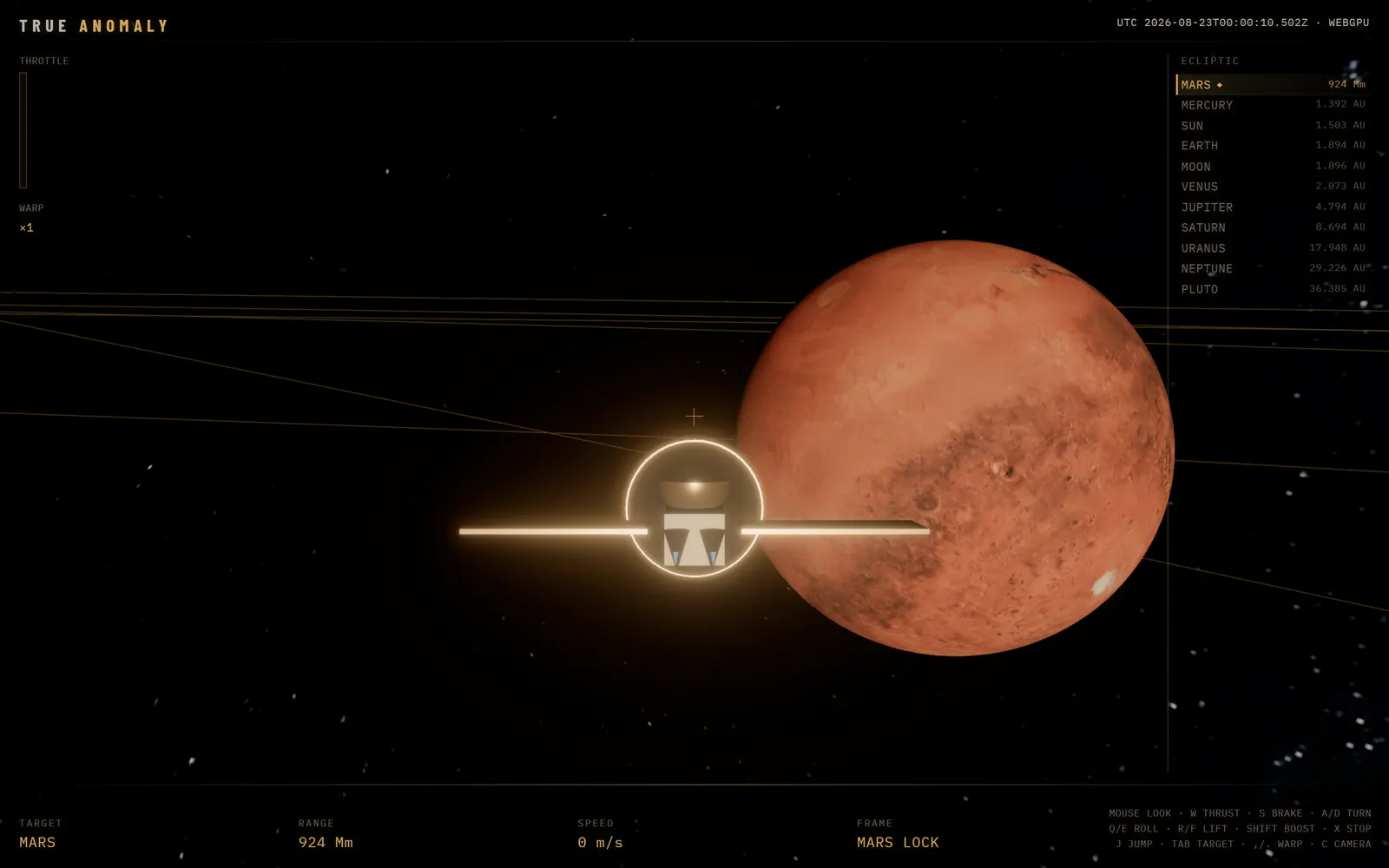 | |
| Mars approach, range in megametres |
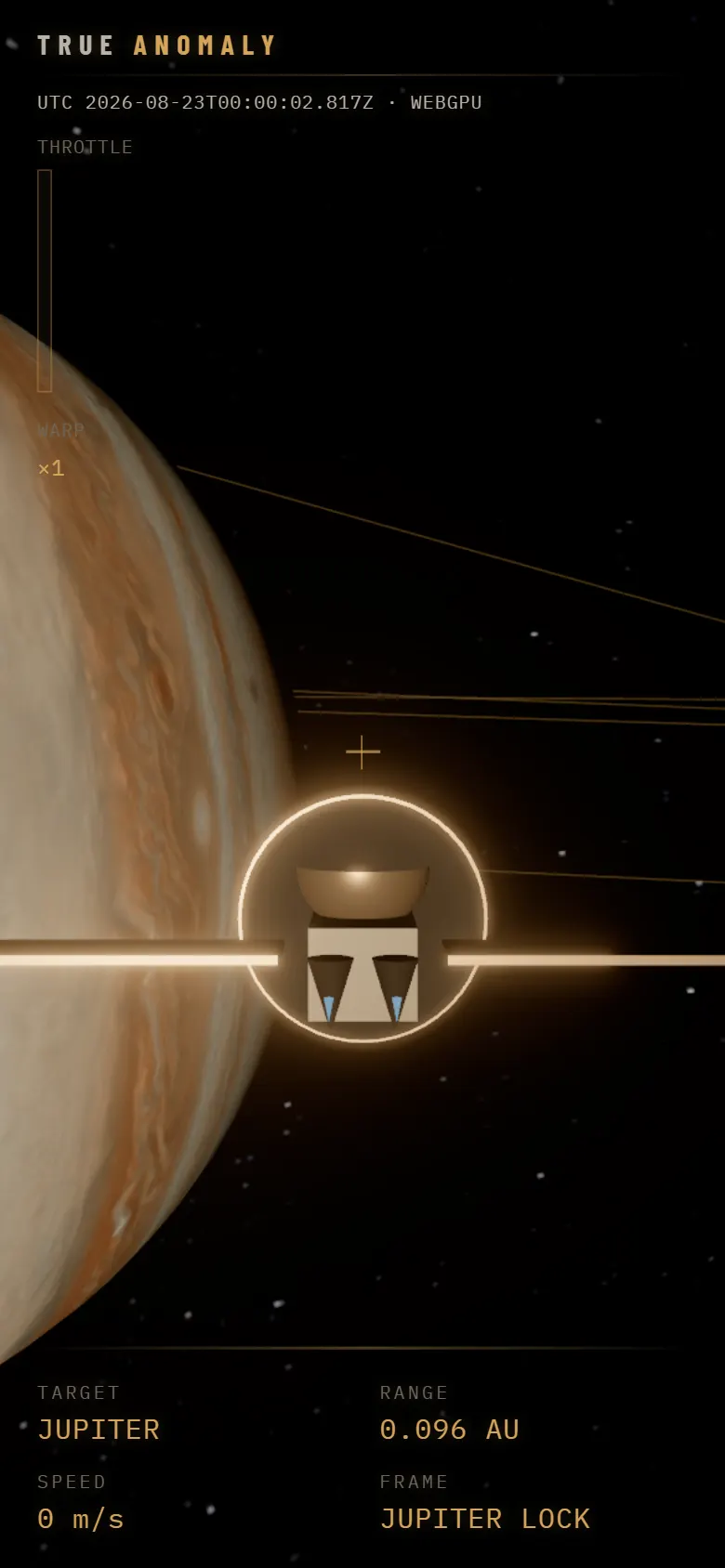
Narrow screens get a compact HUD (flying still needs a keyboard and mouse).
Why it’s interesting
- Real data: body states come from the JPL Horizons API and are baked into
public/data/bodies.json(epoch, physical parameters, orbital elements). - Orbits are propagated with a Newton-iteration Kepler solver (
src/sim/kepler.ts), with a runnable sanity check (npm run check). - The simulation stores true kilometres; only the renderer applies a display scale, so HUD ranges read in real AU/km.
- Runs on Three.js
WebGPURenderer(three/webgpu) with a post-processing pipeline (src/render/Post.ts). - Ship flight model: 6DOF controls, boost, brake, autopilot jump to a selected body, reference-frame lock and time warp.
Run
npm install
npm run bake    # optional: fetch fresh Horizons data and textures
npm run dev
Use a browser with WebGPU (recent Chrome/Edge). Click the canvas to capture the mouse.
Other scripts: npm run build (typecheck + production build), npm run check (Kepler solver check).
The README screenshots come from scripts/capture-screenshots.cjs. It needs Playwright (not a project dependency) and desktop Chrome, and runs Chrome headed because headless Chrome loses the WebGPU device; see the header comment for usage.
Controls
| Key | Action |
|---|---|
| Mouse | Look (nose follows, FPS Y) |
| W | Thrust forward (hold) |
| S | Brake / reverse (hold) |
| A / D | Turn |
| Q / E | Roll |
| R / F | Lift / sink |
| Shift or Space | Boost |
| J | Jump toward selected body |
| Tab | Next nearest target |
| L | Reference-frame lock |
| , / . | Time warp |
| C | Chase / cockpit |
| X | Full stop |
| Esc | Release mouse |
How the data is fetched and baked
scripts/bake-sol.mjs (npm run bake):
- Requests daily state vectors (ecliptic plane, km and km/s) for the Sun, planets, Moon and Pluto from the JPL Horizons API and converts them to orbital elements.
- Adds physical parameters (radius, flattening, rotation period, obliquity, GM) and writes
public/data/bodies.jsonandpublic/data/SOURCES.md. - Downloads 2K planet textures from Solar System Scope and the latest Sun images from NASA SDO into
public/textures/.
If the network is unavailable, mean J2000 fallback elements in the script keep the game bootable. A baked catalog and textures are already checked in, so the bake is optional.
Scale
The simulation uses true kilometres. Display uses 1 AU = 4000 units, planet radii x80, Sun x28 so Mercury’s orbit stays clear of the photosphere.
Credits
- Ephemeris and physical constants: NASA/JPL Horizons System and JPL Solar System Dynamics (https://ssd.jpl.nasa.gov/). NASA/JPL data is generally public domain; please credit NASA/JPL.
- Planet, Moon, Sun and Milky Way textures: Solar System Scope (https://www.solarsystemscope.com/textures/), based on NASA imagery, licensed CC BY 4.0. Attribution required.
- Live solar disk images (AIA 171, HMI intensitygram): NASA Solar Dynamics Observatory (https://sdo.gsfc.nasa.gov/).
- Engine: three.js (MIT).
License
MIT, see LICENSE. Third-party data and textures keep their own terms as listed above.
Built by Sepehr Radmard · LinkedIn · GitHub · more projects on my profile